The 12 Houses in Vedic Astrology: A Practical Reading Guide
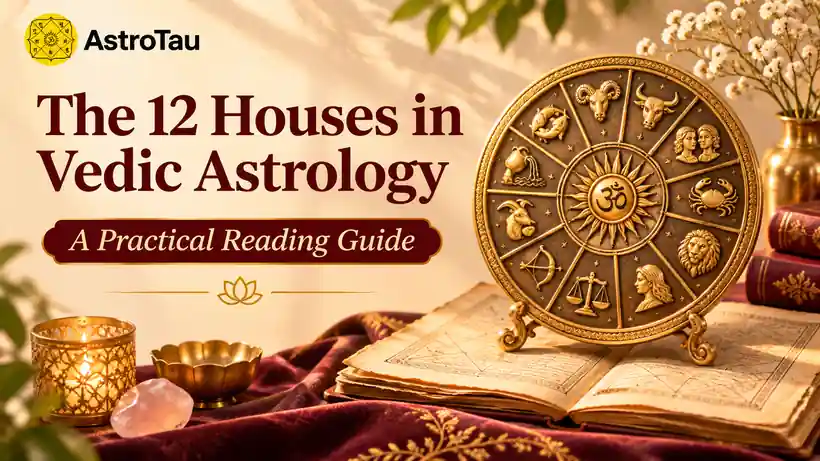
Understand the twelve bhavas, count them correctly from your ascendant, and connect house meanings without turning one placement into a prediction.
THE ASTROTAU JOURNAL
Original guides to birth charts, planetary symbolism, numerology, remedies, traditions and the questions that bring people to astrology.
FIND YOUR NEXT READ

Understand the twelve bhavas, count them correctly from your ascendant, and connect house meanings without turning one placement into a prediction.

A kundli maps the sky for a recorded time and place using an astrological framework. Before interpreting it, verify the birth date, local clock time, historical timezone, birthplace…

Bhakoot is a Moon-sign relationship factor used in the North Indian Ashtakoota matching system. It compares the partners' lunar signs rather than measuring their personalities directly. In the…

For a Pisces Moon, or Meena Rashi, Sade Sati refers to Saturn's sidereal passage through Aquarius, Pisces and Aries. Venus Mahadasha belongs to another timing framework, commonly Vimshottari.…

Shani Dosha is a broad popular expression, not one identical diagnostic rule accepted by every practitioner. It may refer to Saturn's natal condition, Sade Sati, a transit or…

In the conventional Vimshottari sequence, Saturn's nineteen-year Mahadasha is followed by Mercury's seventeen-year Mahadasha. The order identifies the next period, not whether life immediately becomes easier. Other dasha…

In Vimshottari Dasha, the Moon's birth nakshatra determines the first planetary ruler. The fraction of that nakshatra still remaining determines the balance of the period at birth. A…

Rahu Mahadasha is the longer period and Mars Antardasha is a subdivision within it in the Vimshottari system. The combination should not be confused with Mars Mahadasha and…

An Aries Sun, Virgo Moon and Scorpio ascendant form a three-part description, but the signs must come from the same calculation framework to be read consistently. Western tropical…

Paasha, also written Pasa, belongs to the Sankhya group of Nabhasa yogas. Its familiar counting rule concerns the seven classical visible grahas occupying five zodiac signs. It does…

Buddhamaturya Yoga is a name readers encounter in discussions of intelligence, judgment or intellectual ability. Spellings and definitions are not consistently standardized across popular sources. Rather than accepting…

Sama Saptama commonly describes a mutual seventh-house relationship: two placements stand opposite each other in the zodiac. The phrase may appear in natal or compatibility discussions, so the…

Anapha is one of the lunar yogas described in classical Jyotish. In its familiar formulation, one or more qualifying planets occupy the twelfth sign from the Moon, excluding…

Durudhura, often written Durdhara, is a classical lunar yoga involving qualifying planets in both the second and twelfth signs from the Moon. The Sun is excluded in the…

Maha means great, and the expression Maha Yoga can appear as a general description of a powerful combination or as a specific named rule in a particular source.…
Archive dates organize this editorial collection. Each article separately shows when the new content was prepared or updated.
CONNECT THE IDEAS
Use AstroTau’s existing tools alongside the educational guides.
Open the Kundli Calculator ↗