The Mars position stays the same
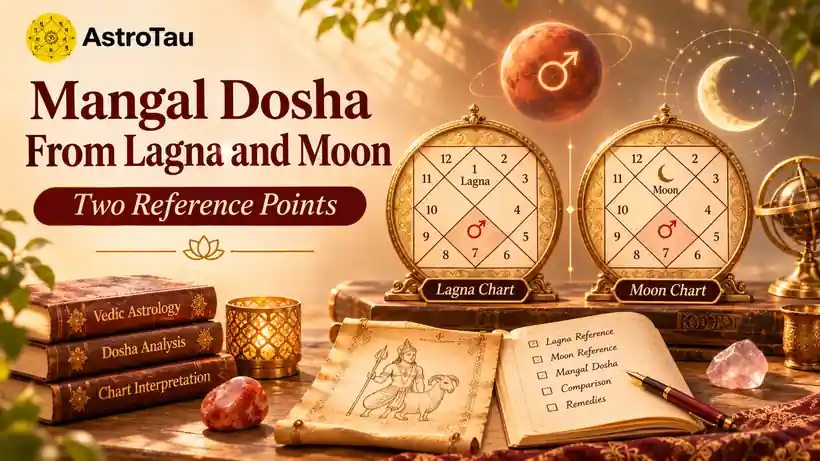
Checking Mangal Dosha from Lagna and from the Moon does not move Mars to a new place in the sky. It changes the starting point for counting houses. Lagna supplies the ascendant-based framework; Chandra Lagna treats the Moon's sign as the first house. Understanding that distinction makes apparently conflicting calculator results easier to compare without assuming that one chart must be incorrect.
Count each framework explicitly
Suppose the ascendant is Aries, the Moon is in Taurus and Mars is in Scorpio. Mars occupies the eighth whole-sign house from Aries and the seventh sign from Taurus. A method examining both reference points could therefore describe two relevant Mars relationships. This is a worked counting example, not a personal prediction. Other house systems or traditions may require additional clarification.
Check which houses the method includes
Common Manglik rules often consider the first, fourth, seventh, eighth and twelfth houses, with the second included in some traditions. Some readers use Lagna alone, while others add Moon or Venus references. Document that choice before comparing results. A label appearing in one framework but not another can reflect the selected rule set rather than an arithmetic error or a change in the person's chart.
Separate technical overlap from risk
Two flagged counts are not two independent scientific measurements of marital danger. They are related descriptions within a traditional system. The natal sign, dignity, aspects, house rulership and wider relationship factors still matter to the interpretation. Adding warning symbols to a report may look precise while concealing uncertainty about how much weight the practitioner actually gives each factor.
Read both partners with equal care
A matching consultation should explain both charts consistently, rather than searching only one person's chart for faults. The Moon-based check may be interpreted in relation to emotional patterns and the Lagna-based check to the wider natal structure, but these are symbolic distinctions. They do not prove someone's behavior or justify unequal treatment, blame or pressure during a marriage decision.
Keep a clear comparison sheet
Write the ascendant sign, Moon sign, Mars sign and the inclusive counts in separate columns. Add the list of houses used by the selected tradition and any claimed exceptions. That record lets another reader reproduce the observation. It also makes it easier to distinguish calculation from interpretation and keeps a complex discussion from becoming an unexplained verdict about the couple's future.
Why Lagna and Moon calculations can disagree
Counting Mars from the ascendant and from the Moon changes the reference point, so the occupied relative house can change. With Aries rising, a Taurus Moon and Mars in Sagittarius, Mars is ninth from the ascendant and eighth from the Moon. Keeping the calculation visible makes it possible to distinguish the underlying observation from the interpretation added to it. It also makes disagreements easier to resolve: first check whether the same inputs and definition were used, then compare what each reading concludes.
For a question about Mangal dosha Lagna chart Moon chart, begin with one clearly defined aim. You may be trying to identify a formation, understand a relationship factor or compare a timing method. Those tasks need different information. Write the question in one sentence and keep it beside the calculation. If an answer moves to a different subject, such as discussing a transit when you asked about a birth placement, return to the original question before deciding what the answer establishes.
The details to check before drawing a conclusion
The first check in this topic is lagna reference. The other items below show why a short label cannot replace a full explanation. A reader should be able to identify the input, follow the relevant count or classification and see how the interpretation relates to the question. When one of those steps is missing, keep it as an open item rather than filling the gap with a confident prediction.
| Detail | What to verify |
|---|---|
| Lagna reference | count signs from the ascendant |
| Moon reference | restart the count from the Moon sign |
| Same planet | Mars retains the same actual longitude |
| Conclusion | report both positions before applying a specified dosha rule |
Turn the reading into a useful next step
Apply the example of Mangal dosha Lagna chart Moon chart in two passes. In the first pass, record only the information that can be checked: a sign, house, longitude, period length, classification or practical requirement. In the second, write the meaning proposed for that information and the additional conditions it depends on. This keeps a symbolic explanation distinct from the underlying measurement. It also prevents a broad description from appearing more specific merely because it includes an unfamiliar technical word.
Finish by identifying one question that would improve the reading. For this guide, useful questions include whether the stated lagna reference is correct, whether the remaining checks have been completed and whether the example genuinely matches your situation. A proportionate next step might be correcting birth details, comparing the same method in two tools or discussing a practical expectation with someone involved. A longer reading is valuable when it clarifies these decisions, rather than adding more labels to an already uncertain conclusion.
Common questions
Does Chandra Lagna require a different birth chart calculation?
It usually reorients the existing sign placements around the Moon rather than recalculating the sky at another time.
Do two Manglik labels mean twice the danger?
No. Multiple counts do not establish a measurable probability of harm or a predetermined relationship outcome.
KEEP EXPLORING
Explore traditional compatibility
Compare the calculated matching factors and read them alongside communication, consent and real-life compatibility.
Explore Kundli Matching ↗