Begin with ordinary variation
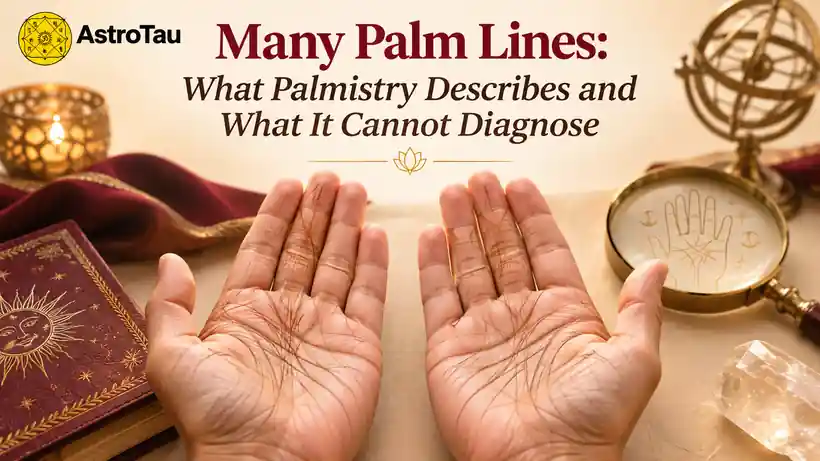
People's palms differ in the number, depth and visibility of creases. Fine lines may appear more noticeable with lighting, hand position or skin condition. In palmistry, readers may attach symbolic meanings to a busy-looking palm, but the appearance alone does not establish a personality type or hidden problem. Describe the feature accurately before treating the phrase too many as a meaningful category.
Distinguish major creases from minor markings
Historical palmistry identifies a small set of major lines and many secondary markings. Different writers name and prioritize those features differently. A reader should explain which crease they mean instead of pointing generally at a dense area. Clear photographs, relaxed hands and consistent lighting are useful for description, although better images do not make a symbolic prediction scientifically reliable.
Understand the traditional associations
Some popular readings link many fine lines with sensitivity, mental activity or complicated interests. These are interpretations within the tradition, not verified assessments. The same pattern might be described differently by another practitioner. If a description seems relevant, compare it with your own experience rather than assuming the palm has independently proved it or revealed a trait you must accept.
Avoid diagnostic shortcuts
The number of visible palm lines cannot diagnose anxiety, illness or a person's ability to cope with stress. Neither can it determine marriage count, intelligence or the likelihood of success. If a physical change concerns you, focus on the change itself and seek appropriate practical advice rather than accepting a divinatory explanation. A dramatic interpretation can add worry without supplying useful evidence.
A calmer way to approach a reading
Ask the palmist to separate what is visible from what they infer. Request one explanation at a time and note where traditions disagree. You do not need to agree with every interpretation or buy a remedy to reduce the number of lines. An optional reading should not leave you believing your hand has diagnosed a permanent condition or removed your ability to make choices.
Keep the observation in proportion
A palm can be interesting as a subject of art, history or cultural symbolism. That interest does not require a prediction about every small marking. If you keep photographs for comparison, use similar conditions and avoid searching for daily signs of fate changing. The most useful outcome is an informed understanding of the tradition's vocabulary while your decisions remain grounded in your life rather than a crease pattern.
Describe the lines before assigning a meaning
Palmistry descriptions commonly distinguish prominent creases called the heart, head and life lines, alongside other markings that may be described as fate, sun or fine secondary lines. These names belong to the interpretive vocabulary. A line called a life line does not measure how many years a person will live, and a busy-looking palm does not establish a medical or psychological condition.
For a useful visual description, note whether a marking is a main crease, a fine surface line, an intersection or a feature emphasized by lighting. Compare photographs taken with the hand relaxed and held in the same position. A small change in how the palm is stretched can change which fine markings appear prominent. Start with what can actually be seen instead of building a personality conclusion from the total number of visible lines.
A practical comparison
| Question or feature | How to approach it |
|---|---|
| Main creases | Describe their path and visibility without treating names as diagnoses |
| Fine lines | Check lighting, hand position and image quality |
| Intersections | Identify the visible crossing before applying a symbolic label |
| Comparison | Use photographs taken under similar conditions |
| Interpretation | Keep palmistry language separate from medical conclusions |
Try this before drawing a conclusion
Choose one clearly visible crease and trace its route in words, without using fortunate, unlucky or stressful. Repeat the exercise with a second photograph in similar light. The result is a more reliable visual description, even if you later choose to explore a symbolic reading.
Revisit your notes about too many palm lines after completing the exercise. Keep the original observation, the interpretation and your chosen response in separate sentences. If a description cannot explain how it moved from the observation to its conclusion, leave that conclusion open. This approach makes a reading easier to understand and gives you a practical way to decide which part, if any, is useful in your own circumstances.
Common questions
Do many fine lines prove I overthink?
No. That is a popular symbolic interpretation, not a reliable assessment of someone’s mental state.
Should I try to remove the lines?
There is no need to alter normal palm creases for an astrological reason. Address physical skin concerns through appropriate care.
KEEP EXPLORING
Explore related symbolic traditions
Read further educational guides and compare the questions each tradition is used to explore.
Browse related guides ↗