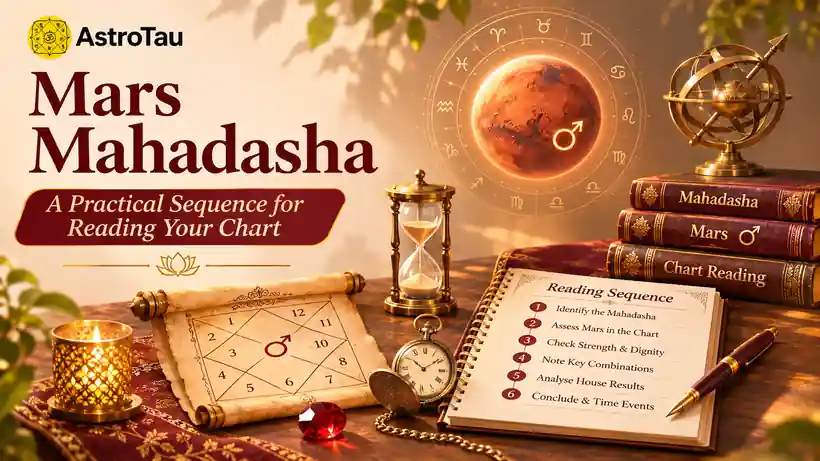
Start with the timing system
In the Vimshottari dasha system, Mars Mahadasha lasts seven years. It is one major period in a sequence calculated from the Moon's birth nakshatra. The phrase does not mean that Mars has physically entered every area of life or that seven years must be difficult. Before interpreting anything, verify the birth time, calculation settings and the actual beginning and ending dates produced by the selected system.
Locate Mars and identify its responsibilities
Record Mars's sign, house and the houses it rules for the ascendant. This matters because the same planet carries different functional roles in different charts. For Cancer rising, Mars rules the fifth and tenth houses. For Gemini rising, it rules the sixth and eleventh. Calling Mars universally beneficial or harmful discards precisely the chart information needed to distinguish those two readings.
Assess condition before predicting events
Traditionally, interpretation considers dignity, conjunctions, aspects and other measures of strength. A planet in its own sign is not the same observation as a planet involved in a difficult conjunction. Write down each observation separately before creating a narrative. Avoid turning familiar Mars words such as heat or conflict into a prediction of an accident, illness or violent behaviour.
Add the antardasha layer
The subperiod introduces another planet's condition and house connections. Mars with Mercury as subperiod ruler may be discussed differently from Mars with Saturn as subperiod ruler because the participating houses and relationships differ. This does not justify a stock forecast for everybody with those period names. Compare the actual placements and check that the software is displaying the same dasha system throughout.
Use past experience carefully
Review earlier transitions with dated notes about work, study, responsibilities or relationships. Look for specific connections rather than selecting only events that fit the interpretation. A new role beginning near a period change may be meaningful to the reader, but timing alone does not establish causation. Record events that do not fit as well; otherwise every possible outcome can appear to confirm the forecast.
Translate symbolism into proportionate action
Mars themes can prompt questions about effort, boundaries, practical skills and the handling of disagreement. If a reading highlights ambition, a useful response might be a realistic training plan or clearer priorities. Major employment, investment or health decisions still need relevant evidence and advice. No gemstone, purchase or ritual is compulsory simply because the seven-year period has begun.
Reading a Mars period beyond one keyword
Mars Mahadasha lasts seven years in the usual Vimshottari system, but its chart responsibilities depend on the ascendant and natal placement. Mars for Leo rising rules the fourth and ninth houses, while for Virgo rising it rules the third and eighth; the same period name therefore connects different subjects. Keeping the calculation visible makes it possible to distinguish the underlying observation from the interpretation added to it. It also makes disagreements easier to resolve: first check whether the same inputs and definition were used, then compare what each reading concludes.
For a question about Mars Mahadasha, begin with one clearly defined aim. You may be trying to identify a formation, understand a relationship factor or compare a timing method. Those tasks need different information. Write the question in one sentence and keep it beside the calculation. If an answer moves to a different subject, such as discussing a transit when you asked about a birth placement, return to the original question before deciding what the answer establishes.
The details to check before drawing a conclusion
The first check in this topic is duration. The other items below show why a short label cannot replace a full explanation. A reader should be able to identify the input, follow the relevant count or classification and see how the interpretation relates to the question. When one of those steps is missing, keep it as an open item rather than filling the gap with a confident prediction.
| Detail | What to verify |
|---|---|
| Duration | seven years in Vimshottari |
| Functional role | houses ruled by Mars for the ascendant |
| Natal condition | occupied sign, house and planetary relationships |
| Subperiod | the Antardasha emphasis within the Mars period |
Turn the reading into a useful next step
Apply the example of Mars Mahadasha in two passes. In the first pass, record only the information that can be checked: a sign, house, longitude, period length, classification or practical requirement. In the second, write the meaning proposed for that information and the additional conditions it depends on. This keeps a symbolic explanation distinct from the underlying measurement. It also prevents a broad description from appearing more specific merely because it includes an unfamiliar technical word.
Finish by identifying one question that would improve the reading. For this guide, useful questions include whether the stated duration is correct, whether the remaining checks have been completed and whether the example genuinely matches your situation. A proportionate next step might be correcting birth details, comparing the same method in two tools or discussing a practical expectation with someone involved. A longer reading is valuable when it clarifies these decisions, rather than adding more labels to an already uncertain conclusion.
Common questions
Is Mars Mahadasha always aggressive or unlucky?
No. Traditional interpretation depends on Mars's roles and condition in the individual horoscope. A period name cannot establish a person's temperament or determine a fixed sequence of events.
Why do two calculators give different dates?
Differences can come from birth data, time zone handling, ayanamsa or calculation settings. Compare those inputs first and record the assumptions before interpreting a disagreement as a meaningful prediction.
KEEP EXPLORING
Understand your own chart
Use the existing calculator to establish the recorded signs and houses before exploring their traditional meanings.
Open the Kundli Calculator ↗