The central interpretation
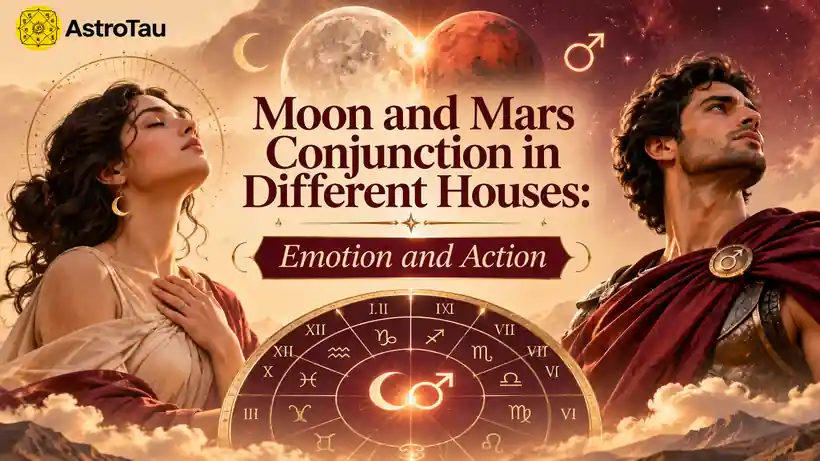
The Moon and Mars bring different kinds of movement into the same part of a birth chart. The Moon represents habits, receptivity and emotional response; Mars represents initiative, assertion and the willingness to confront a task. Traditional interpretation can therefore explore feelings that quickly become action. This does not mean a person is inevitably angry. The useful question is how a response forms and whether there is enough room to choose what happens next.
Where the theme becomes practical
The occupied house identifies the arena. In the third, the pair may symbolize energetic communication and practical learning; in the fourth, attention turns toward privacy and emotional security; in the tenth, involvement may become visible through professional responsibilities. These associations do not promise entrepreneurship, property or fame. A real discussion should also consider skills, relationships, opportunities and the circumstances in which effort is being applied.
An illustrative example
Imagine two colleagues responding to an urgent deadline. One channels concern into a clear task list and asks for help. Another sends a sharp message before understanding the problem. These are different uses of an emotional-action theme, not evidence of either colleague's actual chart. Separating the feeling, its proposed action and the genuinely useful next step can turn a symbolic reading into a practical reflection.
Important chart distinctions
Some schools discuss Moon–Mars relationships as Chandra-Mangala Yoga. Formation rules and qualifying conditions differ. The Moon's phase, planetary degrees, signs, house ownership and other influences all matter. A same-sign conjunction can be wide, while a close pairing may be treated more prominently. Read a named yoga as one technical component rather than a certificate of wealth, a personality diagnosis or an explanation for every disagreement.
A careful reading sequence
A useful reading of Moon and Mars conjunction should leave you with a clear sequence rather than a dramatic verdict. Begin with this question: confirm the house framework and exact planetary degrees. Then compare emotional needs with the preferred style of acting. Write down which parts of the interpretation describe something you can actually observe, and which remain tentative symbols. If the available birth time is approximate, state that uncertainty before discussing houses. Use the remaining checks to turn the reading into a considered conversation rather than a fixed prediction.
- Confirm the house framework and exact planetary degrees.
- Compare emotional needs with the preferred style of acting.
- Check both planets’ house ownership for the ascendant.
- Notice whether urgency improves judgement or simply accelerates it.
A practical situation to compare with the chart
Emotional responsiveness and the impulse to act need separate attention; a quick reaction is not automatically an effective decision. A manager receives abrupt feedback and drafts a reply immediately, then reviews it before sending. In this example, the useful observation is the response to the situation: how a decision is made, what is communicated and which responsibility is accepted. That gives the interpretation a concrete subject instead of leaving it at a list of favorable or difficult adjectives.
A conjunction is judged using actual longitude as well as a shared sign; a wide separation can change the emphasis. A detailed reading should say whether it is discussing a natal placement, a current transit or a planetary period. Those are different observations. The natal placement describes the framework being interpreted; a transit adds a moving relationship, while a dasha selects a traditional timing emphasis. A statement about one layer should not be silently transferred to the others.
Separate the components before interpreting them
Consider Moon and Mars in Aries in a hypothetical Aries-ascendant, whole-sign chart. This is a teaching example, not a chart calculated for a particular person or date. The house identifies identity and personal approach; the participating planets contribute different functions that should not be collapsed into one label. Write these components separately before drawing a combined interpretation. The table keeps placement, sign and rulership visible so that the reasoning can be checked.
| Component | Traditional emphasis | How to read it |
|---|---|---|
| Moon | responsiveness and emotional habits | adaptability, belonging and changes in attention |
| Mars | initiative and assertion | effort, boundaries, competition and the use of force |
| House 1 | identity and personal approach | the way a person begins tasks, presents themselves and responds to their surroundings |
| Sign in the example | Aries | With Aries rising in a whole-sign chart, Aries occupies the first house. |
| Moon as a house ruler | Cancer | In this Aries-rising example, Moon rules house 4. Those house subjects are therefore considered alongside the occupied house. |
| Mars as a house ruler | Aries and Scorpio | In this Aries-rising example, Mars rules house 1 and house 8. Those house subjects are therefore considered alongside the occupied house. |
What can strengthen or change this reading
Moon's full aspects in a common Parashari approach fall on house 7 from this position. Mars's full aspects in a common Parashari approach fall on house 4, house 7, house 8 from this position. An aspect adds a relationship between house subjects; it is not a separate event forecast. To examine identity and personal approach, first assess the occupied house and its ruler, then compare the relevant planetary condition. Exact degrees help establish closeness to other planets, sign boundaries and the Sun where combustion is applicable. Planetary strength should be calculated using the chosen system rather than inferred from a single keyword.
Notice the difference between how you intend to come across and how others describe your conduct. Applied to Moon and Mars, the aim is to distinguish a recurring habit from a temporary circumstance. Record one example of the theme working constructively and one instance where it creates friction. Compare those observations with the original interpretation before adding further combinations. The same house can contain several related subjects, but it does not follow that every person will experience each subject in the same way or at the same time.
House-by-house comparison
Use this overview to locate the area being discussed before comparing signs, rulers or timing. For Moon–Mars, moving from one house to another changes the subject of the interpretation; it does not simply increase or decrease a universal good-or-bad score.
| House | Area to examine | Useful question |
|---|---|---|
| 1 | identity and personal approach | Notice the difference between how you intend to come across and how others describe your conduct. |
| 2 | speech, family values and accumulated resources | Review one recurring expense and one family expectation instead of treating resources only as income. |
| 3 | communication, skills and personal initiative | Choose a skill with a visible output and practise it consistently before assessing your progress. |
| 4 | home, foundations and belonging | Identify what makes your living space workable, then discuss a change with everyone affected. |
| 5 | creativity, learning and personal expression | Complete a small creative or learning project without making outside praise the only measure of its value. |
| 6 | service, routines and practical difficulties | Break a difficult task into responsibilities, deadlines and the support needed to carry them out. |
| 7 | partnership and agreements | Write down what each person has agreed to do and how either person can request a change. |
| 8 | shared resources, privacy and investigation | Clarify ownership, access and responsibilities before making an important shared commitment. |
| 9 | beliefs, teachers and higher learning | Compare a belief with experience and make room for a teacher or viewpoint that challenges your assumptions. |
| 10 | profession, responsibility and public contribution | Define the result expected from your role and the evidence that will demonstrate progress. |
| 11 | networks, gains and longer-term aims | Distinguish a supportive connection from a contact maintained only for access or recognition. |
| 12 | privacy, expenditure and unfamiliar settings | Review where time, attention and money are going, including the quiet activities that help you recover. |
Common questions
Does this conjunction always cause conflict?
No. Courage, protectiveness and productive effort are also possible traditional themes. Actual behaviour cannot be established from one conjunction.
Is this Shashi Mangal Yoga?
Shashi is another name for the Moon. Check the precise conjunction or aspect rule used by the chosen tradition.
KEEP EXPLORING
Locate the placements in your chart
Use verified birth details to calculate planetary positions before applying an isolated placement description.
Open Planetary Insights ↗