What the Grouping Means
Opposite signs are six signs apart; the individual degrees determine whether two planets form an exact 180° aspect.
A Practical Comparison
The comparison involves 10° Aries with 10° Libra, then with 25° Libra. The first pair is exactly opposite and the second is 165° apart.
How Much a Sign Can Tell You
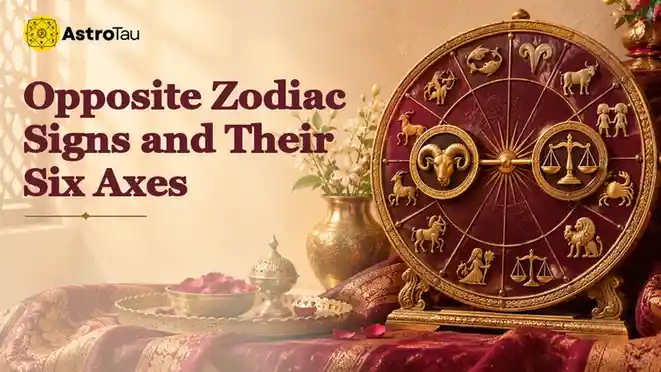
The sign axes are Aries–Libra, Taurus–Scorpio, Gemini–Sagittarius, Cancer–Capricorn, Leo–Aquarius and Virgo–Pisces. For a closer comparison, return to the example in “Equal degrees across opposite signs” below. It is useful to keep the starting situation visible and write the single condition you would vary. The comparison involves what changed after that adjustment before giving the result a broader meaning.
An Opposition Without Rounding the Sign Degrees
Take 29 degrees Aries and zero degrees Libra. Their longitudes are 29 and 180, so their separation is 151 degrees. Now move the Libra placement to 29 degrees and the separation becomes 180. Both examples use opposite signs but only one is exactly opposite by degree. In a chart where the points belong to different houses, also name the activity each house describes. An exercise about independence and agreement works best when you can identify who is deciding and which approval the other person actually needs to give.
Six Axes as a Lookup
Draw the zodiac as twelve equal parts and join each sign with the one six positions ahead. This gives Aries with Libra, Taurus with Scorpio, Gemini with Sagittarius, Cancer with Capricorn, Leo with Aquarius and Virgo with Pisces. A chart with Aries rising therefore has Libra as the opposite whole-sign house. That geometric relationship can help you locate a second point without stating what it means. For interpretation, keep the actual degrees and the two chart factors visible alongside any associated symbolic theme.
Same Context in a Second Example
Take one activity and compare two ways of doing it. It is useful to keep the goal fixed while varying the way a person prepares, starts or follows through. If the second version suits the setting better, note which specific change helps rather than concluding that everyone with one sign makes the same choice.
Bring in the Chart Only
If using an actual chart, locate the point whose sign you are discussing. A sign descriptor by itself gives no house assignment. Relevant considerations include the ascendant and house method before discussing the area of life, and identify the relevant ruler if it contributes to the reading.
Influences on Practical Result
Write what the person tried and how it worked before applying a symbolic interpretation. The question is which detail would change the decision. If the discussion concerns preferences, a person’s own account carries more information than matching them to a list of sign traits.
Equal Degrees Across Opposite Signs
A placement at 12° Taurus is precisely opposite 12° Scorpio. Moving the Scorpio point to 28° leaves the sign relationship unchanged but moves the angular distance to 164°. Write the sign relationship and the distance separately. For a chart reading, identify whether the method uses a sign-based opposition, an allowable degree range or an exact angle. If the reading connects the first and seventh houses, use the ascendant to establish that house axis before interpreting a particular agreement, rather than assuming every opposition occupies those houses.
Actual Points Before Interpreting the Signs
Write the point involved in each example and record whether it is the Sun, Moon or ascendant. Choose one zodiac convention for the comparison. If exact degrees are available, record them before relying on a sign label. A shared group can describe a similarity in the symbolic vocabulary while the placements have different house roles or degrees. For a practical comparison, keep the task fixed and notice how each participant actually approaches it. The example can then show which distinction interests you without assigning everyone with one sign the same preference.
Application of the Symbolism to a Specific Choice
Pick a recent example that fits the comparison and one that does not. Note whether the contrast comes from the circumstances, a different chart placement or a preference you can describe directly.
Common questions
What is the starting point for understanding opposite zodiac signs and their six axes?
Opposite signs are six signs apart; the individual degrees determine whether two planets form an exact 180° aspect.
What factors matter before applying this interpretation?
The sign axes are Aries–Libra, Taurus–Scorpio, Gemini–Sagittarius, Cancer–Capricorn, Leo–Aquarius and Virgo–Pisces.
KEEP EXPLORING
Daily Horoscope
Explore related AstroTau tools and guides.
Explore Daily Horoscope ↗