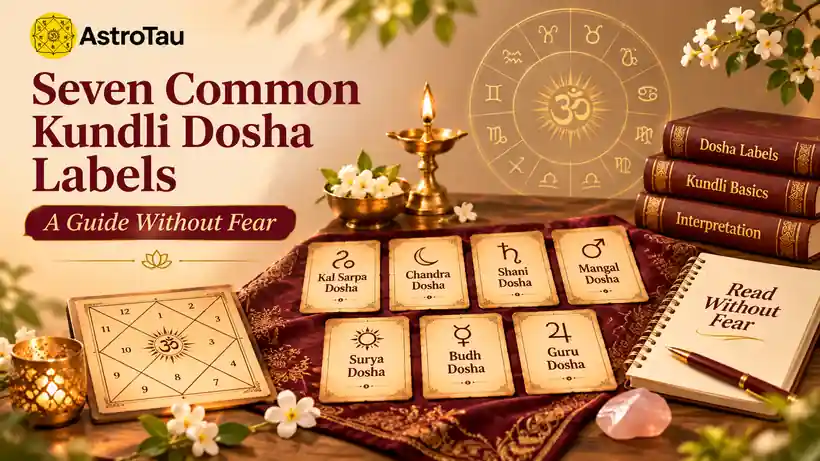
A label needs a definition
Dosha is used in popular astrology for several different kinds of conditions. Some concern planetary placement, others matching scores, and others later interpretive traditions. Calling seven of them dangerous can imply a certainty the calculation does not support. A better approach is to identify the rule, check the underlying chart and ask what practical or spiritual meaning the practitioner intends to attach to it.
Separate marriage-related categories
Mangal Dosha concerns selected Mars relationships under a stated method. Nadi and Bhakoot belong to the Ashtakoota matching framework, using lunar categories and sign relationships. They are not interchangeable diagnoses. A person may receive one label without another because the calculations answer different traditional questions. Each deserves its own explanation rather than being added to a single alarming total.
Understand conjunction-based terms
Grahan-related labels commonly involve the Sun or Moon with lunar nodes, while Guru Chandal descriptions concern Jupiter and Rahu or, in some accounts, node associations more broadly. Exact definitions and closeness criteria vary. A sign-level conjunction is not automatically an astronomical eclipse. Ask whether the source distinguishes a symbolic natal association from a physical event in the sky.
Treat other popular names cautiously
Kaal Sarp usually refers to a claimed enclosure of planets between the lunar nodes, with important variations in counting and interpretation. Pitru Dosha is used inconsistently for several ancestral or chart-related concerns. These names should not be presented as one universally agreed classical checklist. Demand a specific rule before accepting a warning, especially when it is followed by an urgent expensive remedy.
Do not turn astrology into a diagnosis
None of these labels establishes illness, infertility, relationship violence, poverty or inevitable disaster. A matching score cannot replace a medical assessment or a direct understanding of a relationship. If there is a concrete concern, respond to the real circumstances. Cultural practices may be meaningful, but they should remain voluntary and should not create blame toward a child, spouse or family member.
Use a verification worksheet
For each label, record the calculation method, reference point, participating planets, relevant dates and uncertainty in birth information. Separate what can be reproduced from the interpretation that follows. Then ask whether a recommendation addresses a real problem or only the fear created by the label. A responsible consultation should leave the person better informed, with room for choice and without a promise that ritual can control every outcome.
Replacing dosha labels with explicit observations
Different dosha names refer to different rules, and a combined list is not a severity scale. A matching score, a natal Mars placement and a Saturn transit belong to separate assessments even if a conversation groups them under the word dosha. Keeping the calculation visible makes it possible to distinguish the underlying observation from the interpretation added to it. It also makes disagreements easier to resolve: first check whether the same inputs and definition were used, then compare what each reading concludes.
For a question about doshas in kundli, begin with one clearly defined aim. You may be trying to identify a formation, understand a relationship factor or compare a timing method. Those tasks need different information. Write the question in one sentence and keep it beside the calculation. If an answer moves to a different subject, such as discussing a transit when you asked about a birth placement, return to the original question before deciding what the answer establishes.
The details to check before drawing a conclusion
The first check in this topic is category. The other items below show why a short label cannot replace a full explanation. A reader should be able to identify the input, follow the relevant count or classification and see how the interpretation relates to the question. When one of those steps is missing, keep it as an open item rather than filling the gap with a confident prediction.
| Detail | What to verify |
|---|---|
| Category | natal formation, compatibility factor or transit |
| Definition | the exact condition being checked |
| Exceptions | the specific modification rule, if any |
| Response | a proportionate explanation rather than a universal remedy |
Turn the reading into a useful next step
Apply the example of doshas in kundli in two passes. In the first pass, record only the information that can be checked: a sign, house, longitude, period length, classification or practical requirement. In the second, write the meaning proposed for that information and the additional conditions it depends on. This keeps a symbolic explanation distinct from the underlying measurement. It also prevents a broad description from appearing more specific merely because it includes an unfamiliar technical word.
Finish by identifying one question that would improve the reading. For this guide, useful questions include whether the stated category is correct, whether the remaining checks have been completed and whether the example genuinely matches your situation. A proportionate next step might be correcting birth details, comparing the same method in two tools or discussing a practical expectation with someone involved. A longer reading is valuable when it clarifies these decisions, rather than adding more labels to an already uncertain conclusion.
Common questions
Should I count how many doshas a report lists?
A total is not meaningful unless every condition and its role are clearly defined. More labels do not establish greater danger.
Can a dosha label prove a future event?
No. These are categories within astrological traditions, not reliable diagnoses or guaranteed predictions.
KEEP EXPLORING
Understand your own chart
Use the existing calculator to establish the recorded signs and houses before exploring their traditional meanings.
Open the Kundli Calculator ↗