Begin with the trinal houses
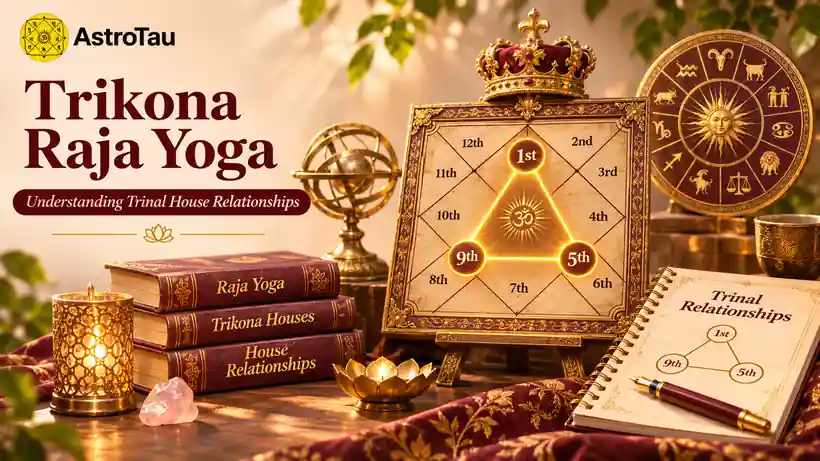
The first, fifth and ninth houses are commonly described as trines, or Trikonas, in Vedic astrology. They connect the overall chart framework with learning, creative intelligence, values and broader guidance in traditional interpretation. The phrase Trikona Raja Yoga is used in popular discussions of favorable house relationships, but an exact formation rule should always be stated rather than inferred from the attractive name.
House rulers matter more than a slogan
Identify the signs in the relevant houses and the planets ruling them. The same planet can rule a trine for one ascendant and different houses for another. Mars, for example, has a different functional role for Cancer rising than for Gemini rising. A general statement that Mars creates success cannot replace the ascendant-specific calculation of what that planet is responsible for in the chart.
Understand the kendra-trikona principle
Many Raja Yoga discussions focus on relationships between angular-house lords and trinal-house lords. Kendras are the first, fourth, seventh and tenth houses. A conjunction, exchange or other stated relationship may be relevant under a particular rule. The actual relation must be identified; merely finding a planet somewhere in a trinal house is not equivalent to demonstrating every condition of a named Raja Yoga.
Consider dignity and competing factors
The planets involved may be in supportive signs, weakened, closely associated with other planets or carrying additional house responsibilities. Those details influence a traditional assessment. A chart can contain several patterns whose meanings are not identical. A careful reader should explain their hierarchy rather than listing favorable combinations and assuming their effects simply accumulate into a guaranteed level of status or prosperity.
Use a restrained practical interpretation
Learning, guidance, initiative and responsibility can provide constructive themes for reflection. A student may use that language to think about study habits or mentorship, but the chart cannot establish educational achievement. A professional can consider opportunities and preparation without assuming that a royal-sounding label guarantees promotion. Real outcomes still require attention to circumstances, effort and the decisions of other people.
Verify the proposed yoga in writing
List the ascendant, the trinal and angular rulers, their positions and the relationship claimed to connect them. Add the textual definition or school and any strength conditions it requires. Then distinguish formation from interpretation and timing. This worksheet makes the discussion checkable and allows an informed question when software reports a yoga that a practitioner describes differently.
Understanding trinal house relationships
The first, fifth and ninth are commonly discussed as trinal houses, while the first, fourth, seventh and tenth are angular houses. A relationship between relevant trinal and angular lords may be examined for Raja Yoga potential, but the exact formation and the planets' condition still need explanation. Keeping the calculation visible makes it possible to distinguish the underlying observation from the interpretation added to it. It also makes disagreements easier to resolve: first check whether the same inputs and definition were used, then compare what each reading concludes.
For a question about Trikona Raja Yoga, begin with one clearly defined aim. You may be trying to identify a formation, understand a relationship factor or compare a timing method. Those tasks need different information. Write the question in one sentence and keep it beside the calculation. If an answer moves to a different subject, such as discussing a transit when you asked about a birth placement, return to the original question before deciding what the answer establishes.
The details to check before drawing a conclusion
The first check in this topic is trinal houses. The other items below show why a short label cannot replace a full explanation. A reader should be able to identify the input, follow the relevant count or classification and see how the interpretation relates to the question. When one of those steps is missing, keep it as an open item rather than filling the gap with a confident prediction.
| Detail | What to verify |
|---|---|
| Trinal houses | first, fifth and ninth |
| Angular houses | first, fourth, seventh and tenth |
| Planetary link | state whether conjunction, aspect or exchange is meant |
| Assessment | consider house ownership and strength before describing effectiveness |
Turn the reading into a useful next step
Apply the example of Trikona Raja Yoga in two passes. In the first pass, record only the information that can be checked: a sign, house, longitude, period length, classification or practical requirement. In the second, write the meaning proposed for that information and the additional conditions it depends on. This keeps a symbolic explanation distinct from the underlying measurement. It also prevents a broad description from appearing more specific merely because it includes an unfamiliar technical word.
Finish by identifying one question that would improve the reading. For this guide, useful questions include whether the stated trinal houses is correct, whether the remaining checks have been completed and whether the example genuinely matches your situation. A proportionate next step might be correcting birth details, comparing the same method in two tools or discussing a practical expectation with someone involved. A longer reading is valuable when it clarifies these decisions, rather than adding more labels to an already uncertain conclusion.
Common questions
Is every planet in a trine a Raja Yoga?
No. A specific relationship or formation rule must be shown; a favorable house location alone is not every named yoga.
Can a trinal combination promise wealth?
No. Traditional symbolic associations do not guarantee a financial or social outcome.
KEEP EXPLORING
Understand your own chart
Use the existing calculator to establish the recorded signs and houses before exploring their traditional meanings.
Open the Kundli Calculator ↗