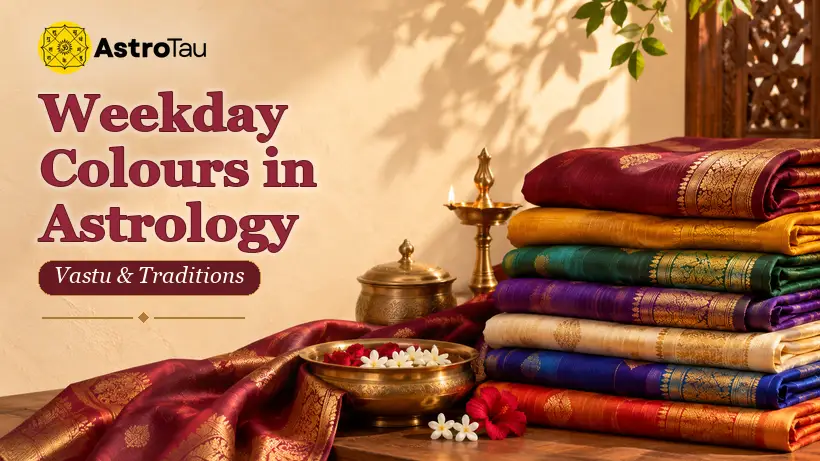
Sunday to Saturday at a glance
One commonly used sequence is Sunday–Sun–red, Monday–Moon–white, Tuesday–Mars–red, Wednesday–Mercury–green, Thursday–Jupiter–yellow, Friday–Venus–white and Saturday–Saturn–dark blue. Red and white each appear twice. Identify the weekday before looking up its colour, and check your source for variants such as black or indigo on Saturday.
How the custom can be approached
Pick one colour already in your wardrobe and write down the weekday tradition it represents for you. Try a small item such as a scarf when the full outfit would interfere with a workplace uniform or the weather. Write down the planet and colour beside each weekday when comparing two lists. If one uses a different colour for Mercury or Venus, check the author's tradition before assuming that one of the lists is incorrect.
What varies by setting
Colour carries practical considerations as well as symbolic ones. Check comfort, lighting and the occasion independently. A family's dress custom may apply specifically to a festival, prayer or visit.
A second example
Imagine a Tuesday colour suggestion arrives before an event with a formal dress code. Wear a neutral outfit with a small red accessory if that suits the custom. Compare it with a Saturday choice that uses a dark blue textile you already own. The weekday reference can be expressed without replacing a wardrobe. A chart may also describe a planet through sign, house or rulership. Those calculations do not come from the colour of a garment. Keep colour preferences and chart data in separate notes.
Identifying the kind of custom
A weekday association can describe a planet, a colour or a local devotional observance. Record the source of each part before joining them together. A family may associate a day with a prayer or offering while using an unrelated colour preference for ordinary clothing.
Planning one ordinary day
Write down the part of the observance you would like to follow and what it requires. Identify a time and place that fit your schedule. If it uses clothing, start by looking at items already available. If it uses a prayer or offering, ask about the words or sequence associated with the practice instead of buying materials based on a broad colour list.
Checking two accounts
When another person follows a different custom on the same day, ask where they learned it and what purpose it serves. Keep both descriptions distinct. The common weekday can help organize the comparison, while the details may depend on a household, temple, region or particular festival.
Compare a weekday colour with a festival colour
Thursday yellow can come from a recurring association with Jupiter, while a festival’s yellow day may come from its own published schedule. If both apply on a particular date, they can coincide for different reasons. Read the headings and dates in a colour table before applying it to another calendar. You can keep the weekday practice manageable by using a small colour cue already available at home. The cue might be a notebook, flower or cloth. Record the association as a family practice so it stays intelligible even when another household uses white or cream for the same occasion.
Use the full seven-day comparison
The weekday–planet sequence gives you a stable order for a colour chart. The associated colours can still overlap. In the example above, Sunday and Tuesday both use red, while Monday and Friday both use white. A colour alone therefore cannot identify a planet or a weekday. If you are making a reference sheet, use columns for the day, graha and colour, with a fourth column for variations from your family or source. That layout makes it easy to see where a different list agrees on the graha but chooses a different shade. Use the day as the starting point when reading a chart of this kind, then compare how the colour is actually used.
A reader comparing a weekday table with a Navaratri chart may see green on Wednesday in the first and a different colour on the same Wednesday in the second. The first follows a repeating seven-day sequence tied to the weekday rulership. The second can follow the order of a particular festival calendar. When sharing a chart, label the convention and the occasion. The source might also specify a shade, such as cream instead of white. That is a useful difference to record for a ceremony and usually an easy variation to accommodate in an everyday practice.
Common questions
Which colours are associated with Thursday and Monday?
Yellow is a common Thursday association for Jupiter. White is a common Monday association for the Moon. A temple or family may have its own custom.
KEEP EXPLORING
Vedic Astrology Guide
Continue exploring this topic with AstroTau.
Explore Vedic Astrology Guide ↗