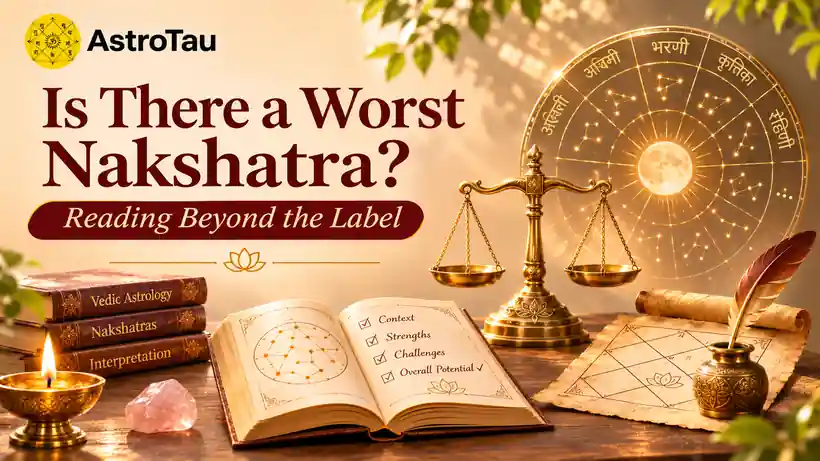
A star name does not rank a person
There is no sound reason to label someone inferior because of a birth nakshatra. Jyotish describes twenty-seven lunar mansions with different symbols, deities, qualities and ritual applications. A star unsuitable for one elected activity may be chosen for another. Turning contextual classifications into a ranking of good and bad people misrepresents both the individual and the diversity of the tradition.
Distinguish natal and electional questions
A natal nakshatra is commonly identified from the Moon's birth position. Muhurta asks whether a particular time suits a selected undertaking. These are different uses. A sharp or fierce description in an electional classification does not establish that people born under it are dangerous. Ask what the classification was designed to describe before applying an emotionally loaded word to someone's life.
Look at the surrounding chart
A traditional reading may consider the nakshatra ruler, its natal condition, the Moon's sign and house, the pada and other planetary influences. Two people sharing one lunar mansion can consequently receive different interpretations. These remain symbolic readings rather than validated personality assessments. They should not replace observing someone's actions, relationships, circumstances or demonstrated abilities in ordinary life.
Notice how fearful descriptions work
A dramatic warning is memorable, and readers may start noticing only events that appear to confirm it. Try recording conflicting observations as carefully as supportive ones. Ask whether the statement is specific enough to test or broad enough to fit almost anyone. If every outcome counts as confirmation, the claim provides little dependable information about an individual, whatever traditional language accompanies it.
Keep matching discussions respectful
Some families extend nakshatra labels into marriage decisions or treatment of children. Such conversations should protect everyone's dignity and agency. A matching method can include lunar factors without implying that a child is unlucky or a partner will damage a household. Consent, mutual respect and real compatibility deserve attention rather than being displaced by a label that nobody explains clearly.
Ask a more useful question
Replace which star is worst with questions about its symbols, textual tradition and relationship with the rest of the chart. Then ask what constructive reflection is actually useful. A responsible explanation can discuss possible challenges without predicting disaster, assigning blame or suggesting that an expensive ritual is required to make a person acceptable. Understanding should leave more room for thoughtful choice, not less.
Why a worst-nakshatra list misleads
A nakshatra is one segment of the lunar zodiac; its symbolic meanings are interpreted through a wider chart and a specific question. A quality described as demanding in one situation may be useful in another, such as persistence in careful research or decisiveness under a clear responsibility. Keeping the calculation visible makes it possible to distinguish the underlying observation from the interpretation added to it. It also makes disagreements easier to resolve: first check whether the same inputs and definition were used, then compare what each reading concludes.
For a question about worst nakshatra, begin with one clearly defined aim. You may be trying to identify a formation, understand a relationship factor or compare a timing method. Those tasks need different information. Write the question in one sentence and keep it beside the calculation. If an answer moves to a different subject, such as discussing a transit when you asked about a birth placement, return to the original question before deciding what the answer establishes.
The details to check before drawing a conclusion
The first check in this topic is position. The other items below show why a short label cannot replace a full explanation. A reader should be able to identify the input, follow the relevant count or classification and see how the interpretation relates to the question. When one of those steps is missing, keep it as an open item rather than filling the gap with a confident prediction.
| Detail | What to verify |
|---|---|
| Position | the Moon’s longitude establishes its birth nakshatra |
| Padas | each nakshatra is divided into four quarters |
| Context | the Moon’s condition and the wider chart |
| Question | explain which life area is actually being considered |
Turn the reading into a useful next step
Apply the example of worst nakshatra in two passes. In the first pass, record only the information that can be checked: a sign, house, longitude, period length, classification or practical requirement. In the second, write the meaning proposed for that information and the additional conditions it depends on. This keeps a symbolic explanation distinct from the underlying measurement. It also prevents a broad description from appearing more specific merely because it includes an unfamiliar technical word.
Finish by identifying one question that would improve the reading. For this guide, useful questions include whether the stated position is correct, whether the remaining checks have been completed and whether the example genuinely matches your situation. A proportionate next step might be correcting birth details, comparing the same method in two tools or discussing a practical expectation with someone involved. A longer reading is valuable when it clarifies these decisions, rather than adding more labels to an already uncertain conclusion.
Common questions
Are fierce nakshatras bad birth stars?
Fierce is a contextual traditional category, particularly in electional use, not a verdict about personal worth or character.
Should a birth star determine a child’s opportunities?
No. A child deserves care, education and respect without being reduced to an astrological category.
KEEP EXPLORING
Find your recorded Moon sign
Explore the Moon-sign tool and its calculated birth details before reading about lunar constellations.
Open the Moon Sign Finder ↗