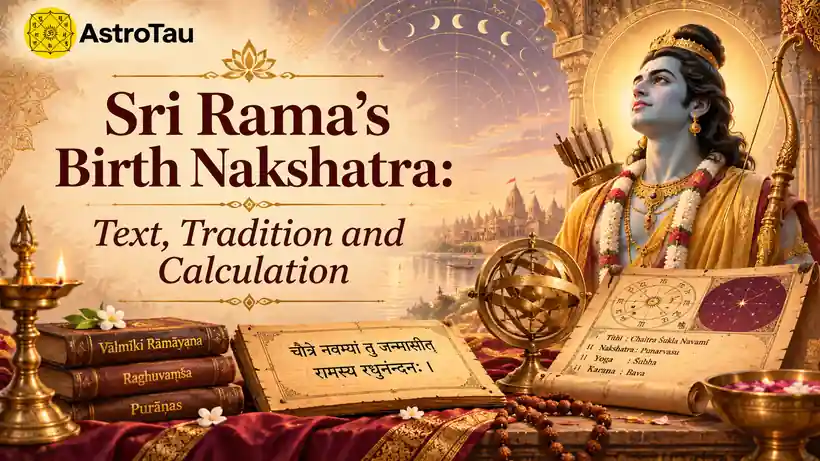
The commonly cited tradition is Punarvasu
In the familiar account of Rama's birth in the Bala Kanda of the Valmiki Ramayana, Punarvasu is the nakshatra traditionally associated with the event. The passage is part of a sacred literary narrative, and interpretations of its astronomical details have a long history. Presenting that traditional identification is different from claiming that modern software has independently established one uncontested historical birth date.
Keep the textual question separate
A reader asking what the narrative says is asking about scripture and interpretation. A reader asking for an exact date in a modern calendar is asking a much more complex historical and astronomical question. Translation choices, calendar reconstruction and assumptions about the sky all matter. One should not silently move from the first question to the second and present a speculative reconstruction as settled fact.
Understand Punarvasu’s zodiac span
In the common twenty-seven-nakshatra sidereal scheme, Punarvasu extends from 20 degrees Gemini to 3 degrees 20 minutes Cancer. Its four padas divide that span into smaller equal portions. This helps explain why a nakshatra name alone does not identify a single zodiac sign in every case. The Moon's precise degree is needed when a calculation asks which part of the mansion is involved.
Read symbolism with its cultural context
Punarvasu is often discussed through themes of renewal, return or restoration, and its presiding deity is traditionally Aditi. Devotional readers may connect such symbolism with the narrative's larger ethical and spiritual themes. Those connections belong to interpretation and faith. They should not be used to claim that everyone born under Punarvasu shares a divine status or must follow a predetermined pattern of life.
Treat modern date claims carefully
Proposed dates for epic events can differ because researchers select different assumptions and evidence. An authoritative-looking chart does not remove that disagreement. When comparing a reconstruction, ask for the source passage, calendar system, astronomical settings and stated limitations. Avoid circulating one date merely because it appears precise to the minute or has been repeated across several websites using the same underlying source.
A useful way to study the topic
Read the birth passage in context, compare a reliable translation with the original terminology where possible, and keep notes on what the text explicitly states. Then separate later devotional interpretations from modern astronomical proposals. This preserves respect for the tradition while allowing careful questions. The topic becomes richer when uncertainty is acknowledged rather than being treated as a problem that must be hidden.
Separating a textual tradition from a reconstructed date
Sri Rama is associated with Punarvasu in a widely followed account of the birth description, while exact historical-date reconstructions depend on additional assumptions. A textual reference to a nakshatra is different from a modern software reconstruction that selects a year, location and astronomical settings. Keeping the calculation visible makes it possible to distinguish the underlying observation from the interpretation added to it. It also makes disagreements easier to resolve: first check whether the same inputs and definition were used, then compare what each reading concludes.
For a question about Sri Rama birth nakshatra, begin with one clearly defined aim. You may be trying to identify a formation, understand a relationship factor or compare a timing method. Those tasks need different information. Write the question in one sentence and keep it beside the calculation. If an answer moves to a different subject, such as discussing a transit when you asked about a birth placement, return to the original question before deciding what the answer establishes.
The details to check before drawing a conclusion
The first check in this topic is traditional association. The other items below show why a short label cannot replace a full explanation. A reader should be able to identify the input, follow the relevant count or classification and see how the interpretation relates to the question. When one of those steps is missing, keep it as an open item rather than filling the gap with a confident prediction.
| Detail | What to verify |
|---|---|
| Traditional association | Punarvasu in a widely followed account |
| Textual question | which passage and interpretation are being used |
| Astronomical question | what assumptions support a reconstructed chart |
| Devotional context | distinguish religious observance from a claim of verified historical dating |
Turn the reading into a useful next step
Apply the example of Sri Rama birth nakshatra in two passes. In the first pass, record only the information that can be checked: a sign, house, longitude, period length, classification or practical requirement. In the second, write the meaning proposed for that information and the additional conditions it depends on. This keeps a symbolic explanation distinct from the underlying measurement. It also prevents a broad description from appearing more specific merely because it includes an unfamiliar technical word.
Finish by identifying one question that would improve the reading. For this guide, useful questions include whether the stated traditional association is correct, whether the remaining checks have been completed and whether the example genuinely matches your situation. A proportionate next step might be correcting birth details, comparing the same method in two tools or discussing a practical expectation with someone involved. A longer reading is valuable when it clarifies these decisions, rather than adding more labels to an already uncertain conclusion.
Common questions
Is Punarvasu the same as Cancer?
No. Punarvasu spans the end of sidereal Gemini and the beginning of Cancer in the common nakshatra scheme.
Does the tradition prove one exact modern birth date?
No. Identifying the literary nakshatra does not resolve all historical and astronomical reconstruction questions.
KEEP EXPLORING
Find your recorded Moon sign
Explore the Moon-sign tool and its calculated birth details before reading about lunar constellations.
Open the Moon Sign Finder ↗