The central interpretation
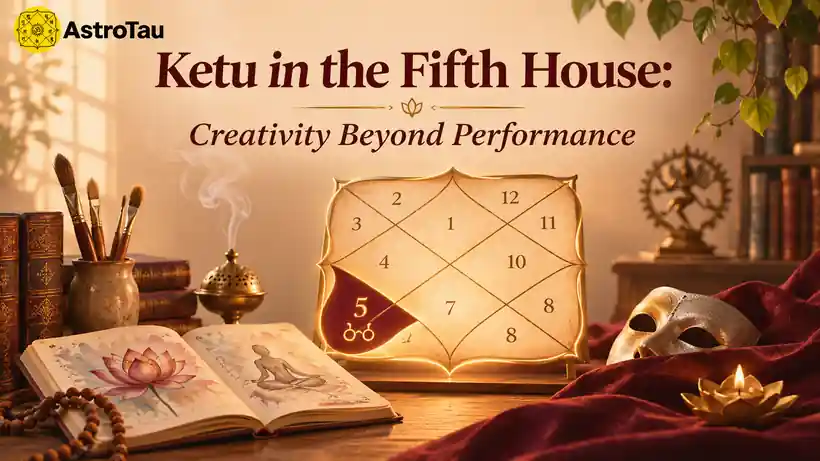
The fifth house is traditionally connected with creative expression, learning and the way an individual develops a personal contribution. Ketu's symbolism of detachment can invite questions about producing work without becoming dependent on applause. This is not a statement that creativity, joy or intelligence is absent. The important distinction is between freely chosen concentration and a loss of interest that needs a more practical explanation.
Where the theme becomes practical
Some people enjoy making something privately but become less engaged when it is ranked or displayed. Others find that public recognition matters less after a period of study. A useful reading asks what keeps curiosity alive and how effort can be supported without turning every interest into a performance. The fifth-house symbol should not be used to prescribe a fixed learning style for a child or adult.
An illustrative example
Imagine a person who loves solving design problems but dislikes entering competitions. They could share work with a trusted peer, keep a private project notebook and choose opportunities that suit their interests. Participation need not be organized entirely around awards. The example illustrates one response to the symbolism rather than a claim about what everyone with Ketu in the fifth should do.
Important chart distinctions
Examine the fifth-house ruler, Ketu's sign lord and the opposite eleventh house of community and gains. Distinguish this general house interpretation from a sign-specific article such as Ketu in Capricorn. Do not predict fertility, children or intelligence from an isolated node placement. Those topics require care, individual circumstances and, where relevant, qualified professional assessment rather than a dramatic astrological conclusion.
A careful reading sequence
A useful reading of Ketu in 5th house should leave you with a clear sequence rather than a dramatic verdict. Begin with this question: identify what makes creative activity satisfying without comparison. Then read the fifth-house ruler and the fifth–eleventh axis together. Write down which parts of the interpretation describe something you can actually observe, and which remain tentative symbols. If the available birth time is approximate, state that uncertainty before discussing houses. Use the remaining checks to turn the reading into a considered conversation rather than a fixed prediction.
- Identify what makes creative activity satisfying without comparison.
- Read the fifth-house ruler and the fifth–eleventh axis together.
- Offer learning different forms of feedback and expression.
- Avoid using a chart label to limit someone’s educational potential.
A practical situation to compare with the chart
Creative satisfaction can come from depth of practice rather than from constant comparison. A musician returns to private study after realizing that audience numbers were directing every choice. In this example, the useful observation is the response to the situation: how a decision is made, what is communicated and which responsibility is accepted. That gives the interpretation a concrete subject instead of leaving it at a list of favorable or difficult adjectives.
Interpretations concerning children require particular care and cannot be reduced to a single planetary placement. A detailed reading should say whether it is discussing a natal placement, a current transit or a planetary period. Those are different observations. The natal placement describes the framework being interpreted; a transit adds a moving relationship, while a dasha selects a traditional timing emphasis. A statement about one layer should not be silently transferred to the others.
Separate the components before interpreting them
Consider Ketu in Leo in a hypothetical Aries-ascendant, whole-sign chart. This is a teaching example, not a chart calculated for a particular person or date. The house identifies creativity, learning and personal expression; the planetary symbolism adds a particular way of approaching those house subjects. Write these components separately before drawing a combined interpretation. The table keeps placement, sign and rulership visible so that the reasoning can be checked.
| Component | Traditional emphasis | How to read it |
|---|---|---|
| Ketu | separation and selective attention | detachment, concentration, established skills and the wish to simplify |
| House 5 | creativity, learning and personal expression | study, creative projects, romance and the confidence to develop an idea |
| Sign in the example | Leo | With Aries rising in a whole-sign chart, Leo occupies the fifth house. |
What can strengthen or change this reading
For the nodes and modern outer planets, aspect rules differ between interpretive schools; name the method rather than implying a universal rule. An aspect adds a relationship between house subjects; it is not a separate event forecast. To examine creativity, learning and personal expression, first assess the occupied house and its ruler, then compare the relevant planetary condition. Exact degrees help establish closeness to other planets, sign boundaries and the Sun where combustion is applicable. Planetary strength should be calculated using the chosen system rather than inferred from a single keyword.
Complete a small creative or learning project without making outside praise the only measure of its value. Applied to Ketu, the aim is to distinguish a recurring habit from a temporary circumstance. Record one example of the theme working constructively and one instance where it creates friction. Compare those observations with the original interpretation before adding further combinations. The same house can contain several related subjects, but it does not follow that every person will experience each subject in the same way or at the same time.
Common questions
Does Ketu in the fifth mean no children?
No. An isolated placement cannot establish a family outcome.
Should creative work remain private?
Not necessarily. The useful choice is how to share it voluntarily and meaningfully, rather than following a rule attached to a placement.
KEEP EXPLORING
Locate the placements in your chart
Use verified birth details to calculate planetary positions before applying an isolated placement description.
Open Planetary Insights ↗