The central interpretation
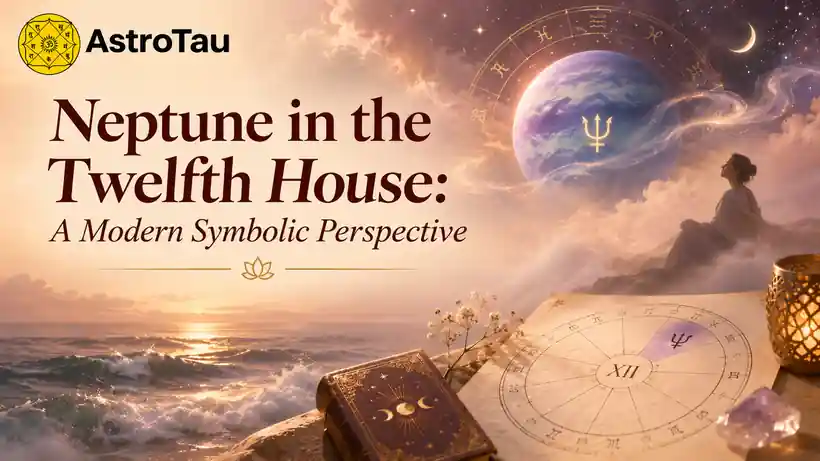
Neptune in the twelfth house belongs to modern astrological interpretation, not the classical nine-graha framework of Jyotisha. Neptune is a physical outer planet, discovered in 1846. Modern astrologers often associate it with imagination, idealization and blurred boundaries. The twelfth is commonly connected with privacy, retreat and activity outside ordinary public attention. These symbolic associations are conventions of interpretation rather than established psychological or predictive facts.
Where the theme becomes practical
Identify the system being used. Combining modern Neptune symbolism with a sidereal Vedic house placement can be a deliberate comparative exercise, but it should not be presented as a classical rule. Traditional planets and the twelfth-house ruler retain their roles within Jyotisha. Neptune moves slowly, so many people share a similar sign placement without sharing the same personality, profession or experiences.
An illustrative example
For a hypothetical writer, the theme could concern the boundary between productive imagination and endless private revision. A quiet workspace may help creativity, while a deadline and outside reader make completion more likely. This illustrates a reflection on privacy and imagination. It does not prove that artists have this placement or that a hidden creative vocation can be established without seeing the person's work.
Important chart distinctions
In relationships, ask whether hope is being confused with evidence. Compassion can coexist with clear agreements about time, availability and money. A twelfth-house placement does not justify diagnosing another person, assuming deception or accepting repeated boundary violations. When a difficult situation needs practical or professional support, symbolic interpretation should remain secondary to facts, personal agency and the right to set ordinary limits.
A careful reading sequence
A useful reading of Neptune in 12th house should leave you with a clear sequence rather than a dramatic verdict. Begin with this question: state whether the method is modern western, vedic or explicitly comparative. Then consider neptune’s slow movement before making highly individual claims. Write down which parts of the interpretation describe something you can actually observe, and which remain tentative symbols. If the available birth time is approximate, state that uncertainty before discussing houses. Use the remaining checks to turn the reading into a considered conversation rather than a fixed prediction.
- State whether the method is modern Western, Vedic or explicitly comparative.
- Consider Neptune’s slow movement before making highly individual claims.
- Translate creative interests into routines with visible completion criteria.
- Distinguish empathy from assumptions about another person’s motives.
A practical situation to compare with the chart
Creative imagination can coexist with a need for clear limits around time, money and expectations. A writer protects quiet working hours while checking that a project has an achievable schedule. In this example, the useful observation is the response to the situation: how a decision is made, what is communicated and which responsibility is accepted. That gives the interpretation a concrete subject instead of leaving it at a list of favorable or difficult adjectives.
Neptune belongs to modern astrological interpretation and is not one of the nine classical Jyotish grahas. A detailed reading should say whether it is discussing a natal placement, a current transit or a planetary period. Those are different observations. The natal placement describes the framework being interpreted; a transit adds a moving relationship, while a dasha selects a traditional timing emphasis. A statement about one layer should not be silently transferred to the others.
Separate the components before interpreting them
Consider Neptune in Pisces in a hypothetical Aries-ascendant, whole-sign chart. This is a teaching example, not a chart calculated for a particular person or date. The house identifies privacy, expenditure and unfamiliar settings; the planetary symbolism adds a particular way of approaching those house subjects. Write these components separately before drawing a combined interpretation. The table keeps placement, sign and rulership visible so that the reasoning can be checked.
| Component | Traditional emphasis | How to read it |
|---|---|---|
| Neptune | imagination and porous boundaries | dreams, ideals, ambiguity and the distinction between inspiration and projection |
| House 12 | privacy, expenditure and unfamiliar settings | retreat, time away, spending, rest and experiences outside familiar structures |
| Sign in the example | Pisces | With Aries rising in a whole-sign chart, Pisces occupies the twelfth house. |
What can strengthen or change this reading
For the nodes and modern outer planets, aspect rules differ between interpretive schools; name the method rather than implying a universal rule. An aspect adds a relationship between house subjects; it is not a separate event forecast. To examine privacy, expenditure and unfamiliar settings, first assess the occupied house and its ruler, then compare the relevant planetary condition. Exact degrees help establish closeness to other planets, sign boundaries and the Sun where combustion is applicable. Planetary strength should be calculated using the chosen system rather than inferred from a single keyword.
Review where time, attention and money are going, including the quiet activities that help you recover. Applied to Neptune, the aim is to distinguish a recurring habit from a temporary circumstance. Record one example of the theme working constructively and one instance where it creates friction. Compare those observations with the original interpretation before adding further combinations. The same house can contain several related subjects, but it does not follow that every person will experience each subject in the same way or at the same time.
Common questions
Is Neptune a member of the Navagraha?
No. The classical nine comprise the Sun, Moon, five visible planets and the two lunar nodes.
Does this placement reveal hidden enemies?
No. Astrological symbolism does not provide evidence that another person is secretly acting against you.
KEEP EXPLORING
Locate the placements in your chart
Use verified birth details to calculate planetary positions before applying an isolated placement description.
Open Planetary Insights ↗