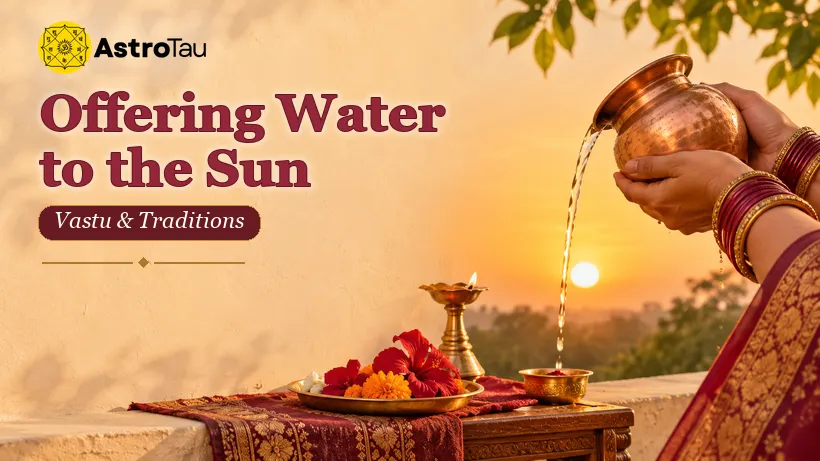
How to prepare for a water offering
Choose the vessel, place and time according to the practice you follow. In a shared space, check where the water will drain before starting. Ask which words or gestures are part of the family sequence if you are learning it.
Meaning and background
Surya arghya refers to an offering of water to the Sun in some Hindu traditions. The vessel, place and recitation may differ depending on the household or teacher.
How the custom can be approached
If you are planning a dawn observance, ask how the vessel is used and where the water should go. Choose a stable spot with drainage and prepare a small amount in advance. Ask how the vessel and offering location are used in the practice you follow. A stable surface or designated drainage spot can keep the routine simple. A respectful observance can be adapted to the physical constraints of your home. Check which parts of the routine are customary and which can be adapted to the space. Avoid looking directly at the Sun as part of the practice.
A second example
If the place you usually use does not drain well, ask where the offering can be made without leaving a slippery surface. Prepare the vessel and recitation in advance if those are parts of the observance you follow. A household may learn a particular sequence from an elder or a teacher. Keep that sequence tied to its source when comparing instructions from another tradition.
Identify the observance before preparing
Ask which text, object or sequence belongs to the practice you are joining. Find out whether you are studying its meaning, participating in a family routine or visiting a temple. Those settings can call for different preparation and different instructions.
Keep text and practice together
If a text is used, record the edition or version. Read a translation or explanation alongside the words you plan to use. If the practice involves materials, prepare the ones required by your community and decide where you can use them comfortably. Ask about a shorter version if the full sequence is unfamiliar.
Learn one part at a time
Write down the opening step and what it represents, then learn how that step connects with the rest of the observance. A short portion practiced with guidance is easier to follow than a long list collected from different sources. Keep a note of what you learned so you can compare later instructions in context.
Plan a safe and repeatable offering
Choose a stable place and an appropriate vessel. Ask whether the practice specifies a time, direction or recitation. In a shared building, plan where the water will go so it does not make a surface slippery or affect neighbours. Compare a temple observance and a home routine by noting which details depend on the space and which carry the meaning of the offering.
Choose an arrangement that suits the location
A courtyard, balcony and shared corridor offer different practical conditions for an offering. Look at where you can stand safely and how water will drain. Then ask which parts of the observance are linked to a particular time or direction and which can be adapted. A simple plan can preserve the intention when the original setting is unavailable. Ask which time, direction, vessel and words are prescribed by the tradition you follow. Keep the vessel ready so you can carry out the sequence without interruptions. In a shared building, check how the water will drain and whether anyone walks through the area. Compare this arrangement with how you would do it in a courtyard or at a temple. A different physical setting can require a different way of handling the water while preserving the part of the act the household considers meaningful.
Common questions
Does the vessel have to be copper?
A copper vessel is customary in some practices. Ask what your community uses and follow the instructions for the specific observance.
KEEP EXPLORING
Vedic Astrology Guide
Continue exploring this topic with AstroTau.
Explore Vedic Astrology Guide ↗