The central interpretation
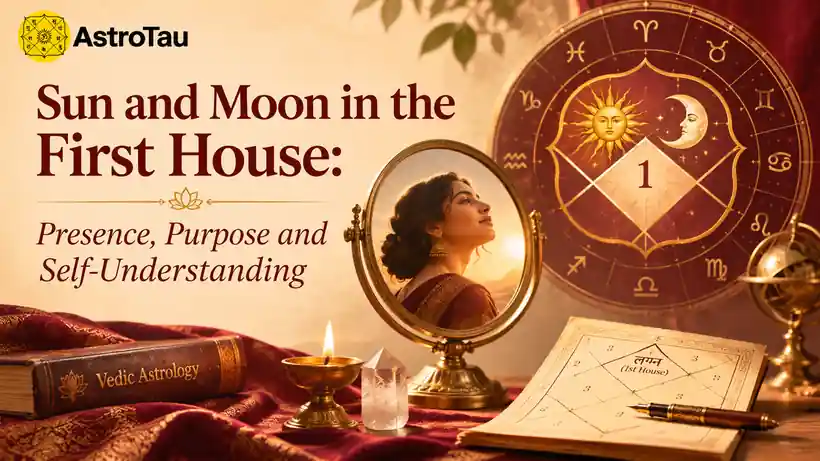
The first house concerns the approach to life and the way an individual meets new situations. With the Sun and Moon together there, traditional interpretation can explore how visible direction and emotional habits are brought into self-presentation. A strong sense of involvement may be a useful theme, but the placement does not make a person automatically confident, self-centred or easy to understand. Identity is more complex than an astrological description.
Where the theme becomes practical
A constructive reading separates presence from performance. Someone can speak clearly about a goal while still needing time to identify their feelings, or appear reserved while having firm convictions. The conjunction should not encourage an astrologer to contradict the person's account of themselves. It can instead provide questions about what feels natural, what requires effort and how social expectations shape a visible role.
An illustrative example
Imagine an individual joining a new team. They want to show commitment but are unsure how much of their personal story to share. A practical approach might begin with the task, explain relevant experience and let trust develop through consistent interaction. The Sun–Moon theme can frame the balance between purpose and familiarity without prescribing extroversion or treating privacy as a lack of confidence.
Important chart distinctions
Accurate birth time is important when assigning a first-house placement. Examine the ascendant ruler, the occupied sign, degrees and Moon phase rather than relying only on the conjunction's name. A broad same-sign pairing is not identical to an exact new Moon. Claims about appearance, health or destiny should remain limited; a natal chart cannot establish a medical condition or determine the value of a person's identity.
A careful reading sequence
A useful reading of Sun Moon conjunction in 1st house should leave you with a clear sequence rather than a dramatic verdict. Begin with this question: confirm the ascendant and the accuracy of the recorded birth time. Then check the sun–moon degrees and the ascendant ruler. Write down which parts of the interpretation describe something you can actually observe, and which remain tentative symbols. If the available birth time is approximate, state that uncertainty before discussing houses. Use the remaining checks to turn the reading into a considered conversation rather than a fixed prediction.
- Confirm the ascendant and the accuracy of the recorded birth time.
- Check the Sun–Moon degrees and the ascendant ruler.
- Distinguish a chosen presentation from pressure to perform a personality.
- Use actual experience to assess whether a description is helpful.
A practical situation to compare with the chart
A strong sense of personal involvement can bring initiative while making feedback feel unusually important. A founder separates criticism of a draft proposal from criticism of personal worth. In this example, the useful observation is the response to the situation: how a decision is made, what is communicated and which responsibility is accepted. That gives the interpretation a concrete subject instead of leaving it at a list of favorable or difficult adjectives.
The Sun’s and Moon’s exact longitudes are needed to assess their angular relationship and lunar phase. A detailed reading should say whether it is discussing a natal placement, a current transit or a planetary period. Those are different observations. The natal placement describes the framework being interpreted; a transit adds a moving relationship, while a dasha selects a traditional timing emphasis. A statement about one layer should not be silently transferred to the others.
Separate the components before interpreting them
Consider Sun and Moon in Aries in a hypothetical Aries-ascendant, whole-sign chart. This is a teaching example, not a chart calculated for a particular person or date. The house identifies identity and personal approach; the participating planets contribute different functions that should not be collapsed into one label. Write these components separately before drawing a combined interpretation. The table keeps placement, sign and rulership visible so that the reasoning can be checked.
| Component | Traditional emphasis | How to read it |
|---|---|---|
| Sun | purpose and authority | self-direction, visibility and the use of responsibility |
| Moon | responsiveness and emotional habits | adaptability, belonging and changes in attention |
| House 1 | identity and personal approach | the way a person begins tasks, presents themselves and responds to their surroundings |
| Sign in the example | Aries | With Aries rising in a whole-sign chart, Aries occupies the first house. |
| Sun as a house ruler | Leo | In this Aries-rising example, Sun rules house 5. Those house subjects are therefore considered alongside the occupied house. |
| Moon as a house ruler | Cancer | In this Aries-rising example, Moon rules house 4. Those house subjects are therefore considered alongside the occupied house. |
What can strengthen or change this reading
Sun's full aspects in a common Parashari approach fall on house 7 from this position. Moon's full aspects in a common Parashari approach fall on house 7 from this position. An aspect adds a relationship between house subjects; it is not a separate event forecast. To examine identity and personal approach, first assess the occupied house and its ruler, then compare the relevant planetary condition. Exact degrees help establish closeness to other planets, sign boundaries and the Sun where combustion is applicable. Planetary strength should be calculated using the chosen system rather than inferred from a single keyword.
Notice the difference between how you intend to come across and how others describe your conduct. Applied to Sun and Moon, the aim is to distinguish a recurring habit from a temporary circumstance. Record one example of the theme working constructively and one instance where it creates friction. Compare those observations with the original interpretation before adding further combinations. The same house can contain several related subjects, but it does not follow that every person will experience each subject in the same way or at the same time.
Common questions
Does this placement make someone naturally extroverted?
No. Social style cannot be settled by one house configuration.
Is the ascendant still important with both luminaries present?
Yes. The ascendant and its ruler remain part of the framework rather than being replaced by the Sun and Moon.
KEEP EXPLORING
Locate the placements in your chart
Use verified birth details to calculate planetary positions before applying an isolated placement description.
Open Planetary Insights ↗