The central interpretation
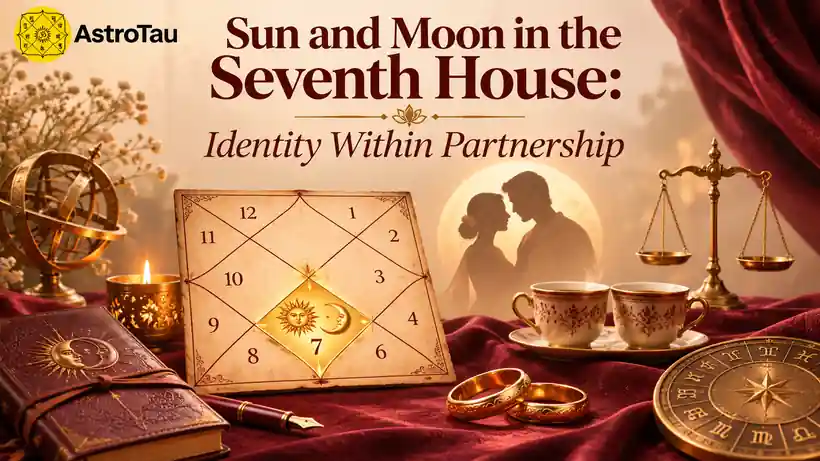
The Sun–Moon conjunction in the seventh house invites a traditional discussion of how personal direction and emotional needs enter a one-to-one agreement. The Sun is associated with purpose and recognition, while the Moon concerns familiarity and responsiveness. Their placement in the seventh can make partnership a useful area for self-reflection. It does not mean the person lacks independence or that a partner will have a particular character.
Where the theme becomes practical
Relationships often expose assumptions that are easy to overlook alone. One person may expect decisions to be made quickly, while another wants reassurance before moving forward. A useful reading asks how expectations are expressed and whether both people retain a voice. It should not present compromise as automatic self-erasure or imply that a chart permits one partner to dominate the other.
An illustrative example
Consider a hypothetical couple planning their working schedules. One values a consistent routine; the other wants flexibility for a new project. They could agree on shared commitments first, identify genuinely flexible periods and review the arrangement after a trial. This gives direction and emotional comfort equal attention. The example illustrates negotiation rather than predicting a marriage, spouse or relationship outcome.
Important chart distinctions
Check the seventh-house ruler, occupied sign and the condition of both luminaries. Planetary degrees and Moon phase help distinguish different Sun–Moon configurations. A broader reading may consider the ascendant and Navamsa within a stated method. None of this replaces communication, consent or evidence of how a relationship actually functions. Technical factors should refine the question, not create a verdict about whether someone deserves a partnership.
A careful reading sequence
A useful reading of Sun Moon conjunction in 7th house should leave you with a clear sequence rather than a dramatic verdict. Begin with this question: state individual needs before assuming they are shared. Then assess the seventh-house ruler and both luminaries. Write down which parts of the interpretation describe something you can actually observe, and which remain tentative symbols. If the available birth time is approximate, state that uncertainty before discussing houses. Use the remaining checks to turn the reading into a considered conversation rather than a fixed prediction.
- State individual needs before assuming they are shared.
- Assess the seventh-house ruler and both luminaries.
- Check whether the conjunction is close or only same-sign.
- Create agreements that leave both people room to revise their views.
A practical situation to compare with the chart
A relationship can become important to both self-definition and emotional security. Partners name personal goals alongside shared plans so that neither disappears into the other. In this example, the useful observation is the response to the situation: how a decision is made, what is communicated and which responsibility is accepted. That gives the interpretation a concrete subject instead of leaving it at a list of favorable or difficult adjectives.
A same-house combination can include different angular distances; avoid treating every chart as an exact conjunction. A detailed reading should say whether it is discussing a natal placement, a current transit or a planetary period. Those are different observations. The natal placement describes the framework being interpreted; a transit adds a moving relationship, while a dasha selects a traditional timing emphasis. A statement about one layer should not be silently transferred to the others.
Separate the components before interpreting them
Consider Sun and Moon in Libra in a hypothetical Aries-ascendant, whole-sign chart. This is a teaching example, not a chart calculated for a particular person or date. The house identifies partnership and agreements; the participating planets contribute different functions that should not be collapsed into one label. Write these components separately before drawing a combined interpretation. The table keeps placement, sign and rulership visible so that the reasoning can be checked.
| Component | Traditional emphasis | How to read it |
|---|---|---|
| Sun | purpose and authority | self-direction, visibility and the use of responsibility |
| Moon | responsiveness and emotional habits | adaptability, belonging and changes in attention |
| House 7 | partnership and agreements | marriage, one-to-one cooperation, business relationships and negotiated commitments |
| Sign in the example | Libra | With Aries rising in a whole-sign chart, Libra occupies the seventh house. |
| Sun as a house ruler | Leo | In this Aries-rising example, Sun rules house 5. Those house subjects are therefore considered alongside the occupied house. |
| Moon as a house ruler | Cancer | In this Aries-rising example, Moon rules house 4. Those house subjects are therefore considered alongside the occupied house. |
What can strengthen or change this reading
Sun's full aspects in a common Parashari approach fall on house 1 from this position. Moon's full aspects in a common Parashari approach fall on house 1 from this position. An aspect adds a relationship between house subjects; it is not a separate event forecast. To examine partnership and agreements, first assess the occupied house and its ruler, then compare the relevant planetary condition. Exact degrees help establish closeness to other planets, sign boundaries and the Sun where combustion is applicable. Planetary strength should be calculated using the chosen system rather than inferred from a single keyword.
Write down what each person has agreed to do and how either person can request a change. Applied to Sun and Moon, the aim is to distinguish a recurring habit from a temporary circumstance. Record one example of the theme working constructively and one instance where it creates friction. Compare those observations with the original interpretation before adding further combinations. The same house can contain several related subjects, but it does not follow that every person will experience each subject in the same way or at the same time.
Common questions
Does this placement guarantee marriage?
No. A single configuration cannot determine marital status or timing.
Can partnership support individuality here?
Yes as a reflective theme, when agreements protect each person’s agency rather than treating identity as something one partner must surrender.
KEEP EXPLORING
Locate the placements in your chart
Use verified birth details to calculate planetary positions before applying an isolated placement description.
Open Planetary Insights ↗