Sun and Venus in a creative example
An artist may enjoy making something privately while someone else decides how it will be presented. Use house and rulership to locate the question and exact separation to check any rule about closeness to the Sun.
Planetary and house symbolism
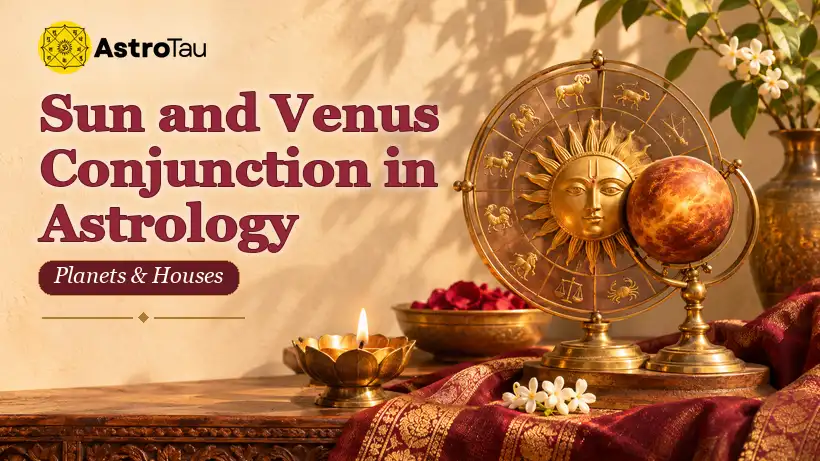
The Sun and Venus can be discussed through identity, visibility, taste and relationships. Determine the separation by degree and the house before using a convention about combustion. Someone can enjoy making an object and still prefer another person to present it. Start with what the maker likes, who will see it and who decides what gets shared. Then record the conjunction's house and both degrees, and ask what degree criterion the astrologer uses if combustion is mentioned. Check the houses each planet rules before assigning any interpretation to the whole relationship or creative project. This gives each traditional association a distinct part of the example.
Worked reading example
In a creative project, compare what the maker wants to express with what an audience needs to understand. Ask which part of the reading concerns style and which concerns recognition or public roles. Compare a close placement with a wider separation before assuming the same combustion interpretation applies. Examine the house and Venus's role in the chart. A relationship topic and an artistic topic can use the same symbols in different ways.
Chart details that change the interpretation
A reader should explain the threshold and convention used for any claim about combustion. Keep the symbolic themes separate from a decision about actual compatibility or career success.
A second example
A chart can show Venus in the same sign as the Sun without satisfying a stated closeness rule. Write down the degrees and compare them with the method the reader uses. Check the sign and house rulership before discussing a consequence. A useful practical comparison is the difference between developing a style you value and presenting it to an audience. The chart reading may give vocabulary for both questions. Start with the occupied house and the topic you are asking about. Then record the sign and the planet that rules it. The houses ruled by the occupying planet can link additional topics to the reading. A sign description alone does not provide those links.
In a hypothetical whole-sign chart, place Sun at 10° Libra and Venus at 16° Libra. Both points occupy the same sign and the separation is 6°. Compare that with a second example where both are at 10° Libra. The house and sign stay the same, but the second pairing is exact by longitude. Use the criteria of the reading method to decide how much weight to give that difference. Treat the placement as a fifth-house question about creative work. Begin by asking what the maker likes and what the audience needs to understand. Then inspect the ruler of Libra, the houses ruled by the planets involved where the method assigns rulership, and any other aspects to the house. These steps give you a comparison that can be checked against the chart instead of assuming a conjunction label answers every question about that area.
Check the comparison point
If the reading concerns two planets, record their exact degrees and say whether your method treats same-sign placement as sufficient. If the reading compares two houses, keep their rulers and occupants on separate lines. Compare only after the calculations refer to the same chart convention.
Tie the placement to a specific question
Identify one event or decision that makes the chart topic relevant. Describe what you already know and what part of the interpretation is a symbolic question. For a work issue, this might mean separating the actual scope of a role from an association with initiative or responsibility. An example with a clear setting is easier to evaluate than a broad personality label.
Check taste, visibility and closeness separately
A person can enjoy making something in private while feeling uncertain about presenting it publicly. Venus and Sun can frame those separate questions. Write their sign, house and degree distance before applying a conjunction or combustion rule. Ask which conditions the reader’s method uses, then check what the person enjoys and what they want others to see.
Compare a private preference with a public decision
A design choice can reflect someone’s own taste, or it can be shaped by the expectations of a group. The Sun and Venus can give a reader two ways to frame those questions. Locate the house and find the rulers before assuming both observations describe the same part of the chart. Then ask who makes the decision and what the person wants to communicate through the result.
Common questions
Does sharing a sign always imply combustion?
No. Interpretive conventions generally consider separation by degree and may use additional conditions.
Can I read the placement on its own?
Start with the general symbolism, then look at rulership and the rest of the chart. A broad description can change when you apply it to a particular ascendant or question.
KEEP EXPLORING
Planetary Insights
Continue exploring this topic with AstroTau.
Explore Planetary Insights ↗