Clarify which half moon you mean
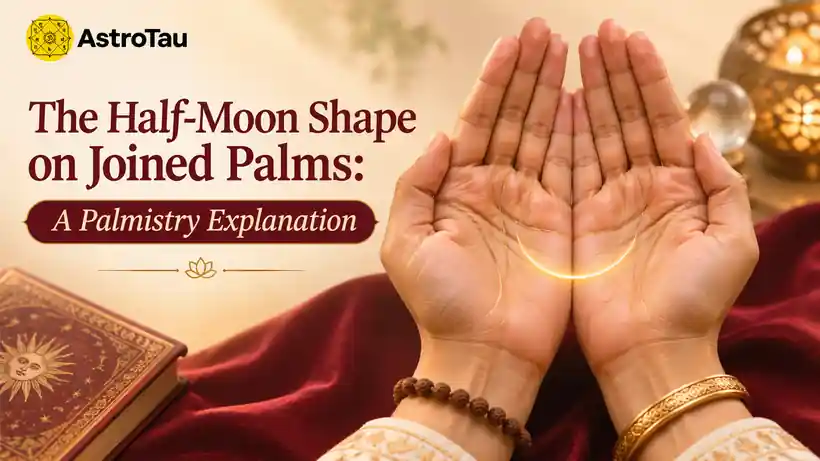
Online palmistry discussions often show two hands placed side by side so that the heart-line creases appear to form a curved or half-moon shape. This is different from the pale crescent, called a lunula, visible on some fingernails. The two should not be confused. Identify the feature in the photograph before applying a symbolic interpretation or repeating a claim made about another part of the hand.
How the joined-palm shape appears
The apparent curve depends on where the hands meet, how the fingers are held and the visible paths of the creases. Small changes in position can change how neatly the lines align. An attractive photograph is therefore not a standardized measurement. Looking at each hand separately helps explain the shape without assuming it reveals a hidden fact about someone's marriage, personality or future partner.
Understand the symbolic language
Palmists often associate the heart line with affection and emotional expression. Different writers interpret its shape, starting point and branches differently. Those are conventions within a divinatory tradition, not a validated test of emotional maturity or compatibility. The visual impression of a crescent should not be converted into a universal promise that someone is especially loyal, destined for a certain partner or guaranteed a happy relationship.
Compare both hands carefully
If you explore palmistry for cultural interest, use relaxed hands under similar lighting and note which convention the reader follows for dominant and non-dominant hands. Keep observation separate from interpretation. A mismatch between the two heart lines is not evidence that someone is unable to love or will face relationship failure. Ordinary anatomical variation deserves a more neutral description than a dramatic social judgment.
Avoid health and lifespan claims
Neither the joined-palm curve nor a fingernail crescent provides a reliable basis for predicting lifespan, fertility or future illness. A symbolic reading should not be used to explain a physical concern. If there is a new symptom or unusual change, the useful question concerns the change itself and appropriate care, not whether an internet shape comparison has revealed a hidden destiny.
Turn interest into a respectful discussion
A lighthearted comparison can become a conversation about cultural traditions or the history of palmistry. It should leave people free to disagree with a reading. Ask what source the interpretation follows and whether the same claim is made consistently. The appeal of a symmetrical shape can be appreciated without treating it as permission to judge someone's relationships, worth or choices.
Check whether the image shows creases or nail crescents
The joined-palms half-moon image usually concerns the alignment of crease patterns when two hands are brought together. A nail crescent is a different feature, commonly called a lunula. Before reading a description, identify which part of the hand the author or photograph is discussing. The same phrase half moon is not enough to make the two subjects interchangeable.
In the joined-palms version, position changes the image. Raising one hand slightly, spreading the fingers differently or rotating the wrists can alter the apparent curve. A photograph showing a neat crescent therefore demonstrates a pose and the visible creases, rather than a standardized measurement of a future marriage. Looking at each palm separately helps reveal how the combined outline was formed.
A practical comparison
| Question or feature | How to approach it |
|---|---|
| Joined-palms shape | A visual alignment produced by two palms and their creases |
| Nail crescent | A different feature located at the base of some nails |
| Position check | Keep hands at a comparable height and angle |
| Photographic check | Look for lighting or cropping that emphasizes the curve |
| Meaning | Treat any palmistry interpretation as a symbolic convention |
Try this before drawing a conclusion
Look at the two hands separately, then compare the combined image without changing the camera angle. Describe which crease contributes to each side of the curve. That observation explains more about the visible shape than a claim about the personality or age of a future partner.
Revisit your notes about half moon on palm meaning after completing the exercise. Keep the original observation, the interpretation and your chosen response in separate sentences. If a description cannot explain how it moved from the observation to its conclusion, leave that conclusion open. This approach makes a reading easier to understand and gives you a practical way to decide which part, if any, is useful in your own circumstances.
Common questions
Is the palm half moon the same as the nail lunula?
No. Viral palmistry posts often concern joined heart lines, while a lunula is a feature at the base of a nail.
Does a matching curve guarantee a good marriage?
No. Relationship quality cannot be established from how two hand creases appear when the palms are joined.
KEEP EXPLORING
Explore related symbolic traditions
Explore AstroTau guides and compare the questions each tradition is used to explore.
Browse related guides ↗