Identify the three branches before reading the mark
Trace all three strokes back toward the same junction. If two begin at different points, compare the pattern with intersecting creases. Record the location and parent line because traditional descriptions use both.
Recognizing the symbol or pattern
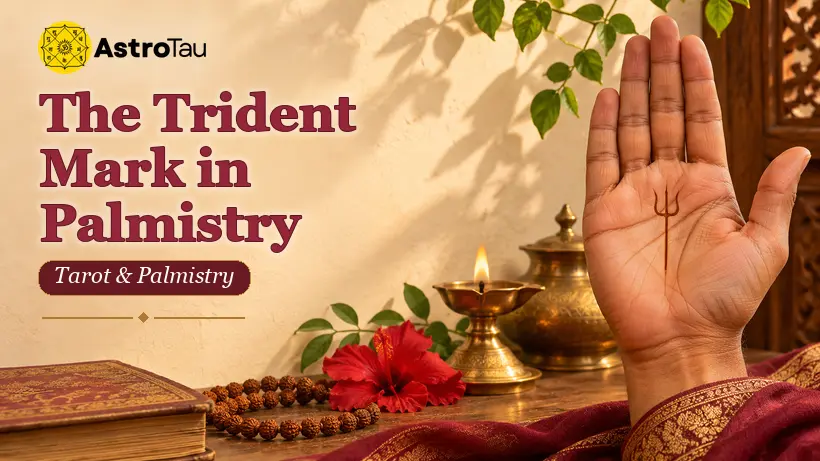
A trident shape usually describes three short branches sharing a stem. In palmistry its interpretation can vary according to whether it appears at the end of a principal crease or in another area.
A worked observation
Draw the stem first and mark each branch where it visibly joins. If two separate lines merely cross the proposed stem, keep that as a second possible explanation. Use the relaxed hand for comparison. A small fork at the end of a major line and a trident-like crossing elsewhere are different descriptions. Sketch their placement first. Some interpretation systems give more weight to the location than to the overall resemblance. The description depends on location and clarity. A mark that resembles a fork in one viewing angle may be a different pattern once the hand moves.
A second example
A trident near the end of a crease should be located by reference to that crease. Draw the junction and check whether all branches are visible under the same light. A faint nearby mark may belong to another crease. Ask a reader to point to the exact feature they are interpreting. That lets you compare the observation with a diagram without needing to agree about a symbolic meaning.
Use consistent observation conditions
Rest the hand in a comfortable position under a steady light. Record the side of the hand and the position of the mark relative to nearby major creases. A small sketch can be easier to compare than a photograph taken from an angle. Make the first record before reading an interpretation.
Describe changes in visibility
Compare the same area from a second angle or with the hand relaxed again. A mark may be clearer when the skin is stretched. If you compare both hands, give each its own sketch and do not move a line from one drawing to the other because they look similar. Keep unclear marks labeled as uncertain.
Identify the reading convention
Different palmistry diagrams can divide the same area differently. Note the name of the convention and which physical feature led you to use it. The drawing is your observation and the interpretation is an additional layer. Keeping those separate makes it easier to discuss a disagreement about the pattern.
Check whether three strokes meet at a shared point
Trace each stroke beyond the apparent junction. A fork at the end of a crease differs from another line crossing it in the middle. Mark where any endpoint is hidden in a fold. Compare diagrams that describe the same part of the hand, because traditional interpretations can depend on the location and parent crease as well as the shape. Trace each stroke from the apparent junction to its endpoint. If the middle line continues through the junction and the other strokes begin at different places, record that pattern before calling it a trident. Look for a shared origin and identify any major crease the mark joins. Then compare palmistry descriptions of the same location, rather than choosing an illustration with a superficially similar outline. A clearer drawing helps you understand which features the interpretation actually uses.
Compare a line ending with a mark on a separate area
A trident-like fork can appear at the end of a line, where all branches extend from the same point. A small mark elsewhere may resemble it but have no identifiable parent crease. Use palm landmarks to locate each mark before comparing meanings. If a book gives one description for a mark near a finger and another for a fork at a crease ending, check which example matches your observation.
Common questions
Should every three-way crossing be called a trident?
Check that the three branches share a common stem. A crossing may involve independent creases.
How can I use the interpretation?
Use it to identify a question worth reflecting on. The scene or symbol alone cannot establish an event or another person’s private thoughts.
KEEP EXPLORING
AstroTau Journal
Continue exploring this topic with AstroTau.
Explore AstroTau Journal ↗