Why trees accompany the nakshatras
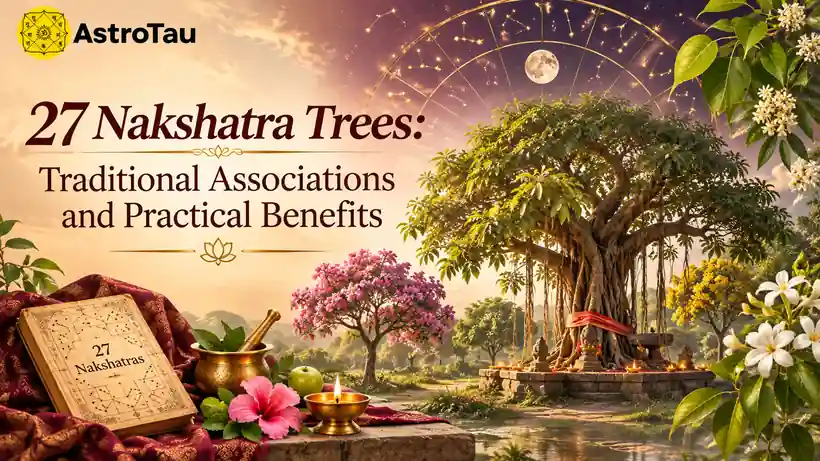
Nakshatra trees connect the twenty-seven lunar mansions with plants in Indian garden and devotional traditions. A nakshatra garden makes that relationship visible through labelled planting. Its clearest benefits are opportunities to learn about local species, create shade and protect biodiversity. A tree does not need to change planetary influences to have cultural or ecological value. Associations differ between regions and institutions, so one list should not be presented as the only authentic version.
A documented set of associations
The following examples follow the public nakshatra garden list published by ICAR's Central Coastal Agricultural Research Institute. Where that list gives alternatives, this selection uses one example. Common names are convenient for orientation; confirm botanical identity with a nursery before planting. Several traditional trees grow very large, and some contain toxic parts. These are planting associations, not instructions to eat, apply or prepare a remedy.
- Ashwini: poison nut; Bharani: amla; Krittika: cluster fig.
- Rohini: jamun; Mrigashira: khair; Ardra: Indian rosewood.
- Punarvasu: bamboo; Pushya: peepal; Ashlesha: nagkesar.
- Magha: banyan; Purva Phalguni: palash; Uttara Phalguni: white fig.
- Hasta: jasmine; Chitra: bael; Swati: arjun.
- Vishakha: wood apple; Anuradha: bakul; Jyeshtha: red silk cotton.
- Mula: golden shower; Purva Ashadha: rattan; Uttara Ashadha: jackfruit.
- Shravana: coconut; Dhanishtha: shami; Shatabhisha: kadamb.
- Purva Bhadrapada: mango; Uttara Bhadrapada: neem; Revati: mahua.
Choose a suitable site first
Start with climate, available soil, mature canopy and distance from buildings. A banyan associated with Magha is unsuitable for a small balcony or a narrow boundary. A person can support an appropriately managed community garden instead of squeezing a sacred tree into an unsafe space. Check underground services and local planting rules before digging.
Understand what benefits actually mean
Shade, habitat, soil protection and a connection with seasonal growth are practical possibilities, depending on the species and setting. They are different from promises of wealth, marriage or relief from illness. An association with a birth star does not establish a medical benefit. Avoid swallowing seeds, bark or extracts because a spiritual list calls the tree auspicious.
Create a maintainable nakshatra garden
A useful garden has accurate labels, a watering plan and enough room for roots. Record the chosen source, regional name, botanical identification and any alternative association. Grouping every tree tightly around a decorative circle may look attractive initially but create overcrowding later. A smaller educational collection with healthy plants is more useful than twenty-seven stressed specimens.
Make the tradition accessible
You can mark a birth nakshatra by sponsoring care for an existing tree, recording its flowering season or learning its local name. People without gardens can visit a botanical collection. Treat the association as an invitation to stewardship, rather than an obligation to buy a particular expensive plant. Long-term care gives the symbolism a tangible expression.
Using nakshatra-tree traditions responsibly
Tree associations are preserved through regional practices and lists, so a common name should be matched to a botanical identification before planting. A tree suitable for a temple grove may be unsuitable for a small courtyard because of roots, mature size or local water conditions. Keeping the calculation visible makes it possible to distinguish the underlying observation from the interpretation added to it. It also makes disagreements easier to resolve: first check whether the same inputs and definition were used, then compare what each reading concludes.
For a question about 27 nakshatra trees, begin with one clearly defined aim. You may be trying to identify a formation, understand a relationship factor or compare a timing method. Those tasks need different information. Write the question in one sentence and keep it beside the calculation. If an answer moves to a different subject, such as discussing a transit when you asked about a birth placement, return to the original question before deciding what the answer establishes.
The details to check before drawing a conclusion
The first check in this topic is identification. The other items below show why a short label cannot replace a full explanation. A reader should be able to identify the input, follow the relevant count or classification and see how the interpretation relates to the question. When one of those steps is missing, keep it as an open item rather than filling the gap with a confident prediction.
| Detail | What to verify |
|---|---|
| Identification | confirm the botanical species, not only a popular name |
| Site | allow for mature canopy and roots |
| Ecology | check local climate, water needs and native suitability |
| Care | plan watering, protection and long-term maintenance |
Turn the reading into a useful next step
Apply the example of 27 nakshatra trees in two passes. In the first pass, record only the information that can be checked: a sign, house, longitude, period length, classification or practical requirement. In the second, write the meaning proposed for that information and the additional conditions it depends on. This keeps a symbolic explanation distinct from the underlying measurement. It also prevents a broad description from appearing more specific merely because it includes an unfamiliar technical word.
Finish by identifying one question that would improve the reading. For this guide, useful questions include whether the stated identification is correct, whether the remaining checks have been completed and whether the example genuinely matches your situation. A proportionate next step might be correcting birth details, comparing the same method in two tools or discussing a practical expectation with someone involved. A longer reading is valuable when it clarifies these decisions, rather than adding more labels to an already uncertain conclusion.
Common questions
Must I plant only my birth nakshatra tree?
No. The association is a cultural practice, not a restriction on which trees you may appreciate or grow. Site suitability and responsible maintenance come first.
Why do two nakshatra tree lists differ?
Regional practices, common names and alternative species can produce different lists. Use a named source, identify the actual plant and acknowledge alternatives rather than assuming one list proves another false.
KEEP EXPLORING
Find your recorded Moon sign
Explore the Moon-sign tool and its calculated birth details before reading about lunar constellations.
Open the Moon Sign Finder ↗