Locate Mula before interpreting it
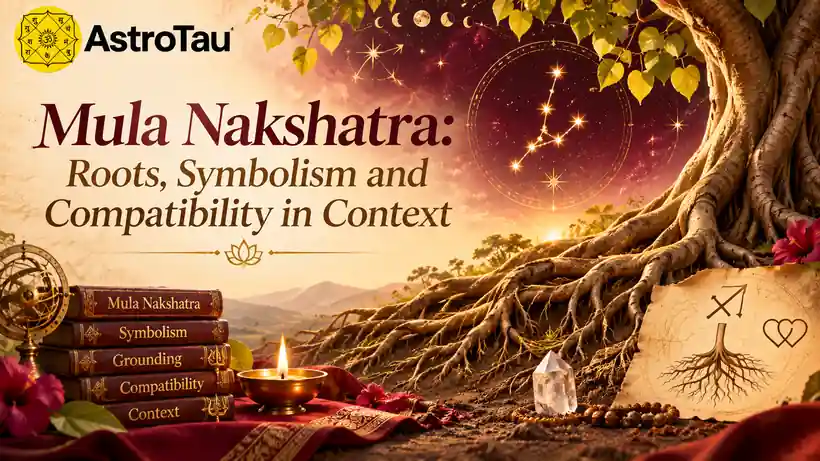
Mula, also spelled Moola, occupies the first 13 degrees 20 minutes of sidereal Sagittarius in the common twenty-seven-nakshatra scheme. Its symbol is associated with roots, its presiding deity with Nirriti, and its Vimshottari ruler with Ketu. These identifiers provide the traditional framework. They do not establish a person's character, future or capacity to form a respectful relationship.
Read the root image constructively
A root can suggest investigation, foundations or the wish to understand what lies beneath a surface explanation. Someone may use that image to reflect on research, problem-solving or assumptions they want to examine. It is not proof that every Mula-born person is disruptive. Symbolism becomes more useful when it opens a question rather than dictates a fixed identity or turns an unfamiliar deity name into fear.
Understand the wider chart context
The Moon's pada, house position, Jupiter as Sagittarius's ruler and Ketu's condition may enter a traditional natal reading. Other planets and the ascendant add further variation. Two people sharing Mula therefore need not resemble one another in ordinary life. A brief nakshatra description cannot replace a full explanation, and a full explanation remains a cultural interpretation rather than an established personality measurement.
Discuss Gandanta without stigmatizing birth
Mula begins at a water-to-fire sign junction, a boundary discussed in Gandanta traditions. Schools differ in how narrowly they define the sensitive interval and what ritual customs they attach to it. Do not treat the entire nakshatra or a newborn child as dangerous. Families can honor a voluntary custom without assigning blame or assuming that a birth placement predicts harm to relatives.
Keep compatibility centered on people
Matching methods may include nakshatra factors, but one star name cannot decide whether a couple communicates, shares values or respects boundaries. Ask which matching rule is being applied and consider both charts consistently if astrology is part of the discussion. Actual consent and behavior remain essential. A tradition should not be used to justify rejection, coercion or unequal treatment on the basis of a frightening stereotype.
Choose a grounded reflection exercise
Identify one area where understanding the foundation would help: a learning goal, recurring disagreement or work process. Write the assumptions, available evidence and questions still unanswered. This gives the root symbol a constructive use without promising a predetermined vocation or outcome. You can appreciate Mula's imagery while allowing your own experience, relationships and changing circumstances to shape what the symbol means to you.
Locating Mula precisely
Mula is commonly counted as the nineteenth nakshatra and spans the first thirteen degrees and twenty minutes of sidereal Sagittarius. A Moon at ten degrees Sagittarius falls within Mula under this segmentation, while a position beyond thirteen degrees twenty minutes moves into the next nakshatra. Keeping the calculation visible makes it possible to distinguish the underlying observation from the interpretation added to it. It also makes disagreements easier to resolve: first check whether the same inputs and definition were used, then compare what each reading concludes.
For a question about Mula nakshatra characteristics, begin with one clearly defined aim. You may be trying to identify a formation, understand a relationship factor or compare a timing method. Those tasks need different information. Write the question in one sentence and keep it beside the calculation. If an answer moves to a different subject, such as discussing a transit when you asked about a birth placement, return to the original question before deciding what the answer establishes.
The details to check before drawing a conclusion
The first check in this topic is zodiac span. The other items below show why a short label cannot replace a full explanation. A reader should be able to identify the input, follow the relevant count or classification and see how the interpretation relates to the question. When one of those steps is missing, keep it as an open item rather than filling the gap with a confident prediction.
| Detail | What to verify |
|---|---|
| Zodiac span | zero to thirteen degrees twenty minutes Sagittarius |
| Sequence | nineteenth of the twenty-seven nakshatras |
| Period lord | Ketu in the Vimshottari assignment |
| Symbolic emphasis | roots, inquiry and the foundations of a subject |
Turn the reading into a useful next step
Apply the example of Mula nakshatra characteristics in two passes. In the first pass, record only the information that can be checked: a sign, house, longitude, period length, classification or practical requirement. In the second, write the meaning proposed for that information and the additional conditions it depends on. This keeps a symbolic explanation distinct from the underlying measurement. It also prevents a broad description from appearing more specific merely because it includes an unfamiliar technical word.
Finish by identifying one question that would improve the reading. For this guide, useful questions include whether the stated zodiac span is correct, whether the remaining checks have been completed and whether the example genuinely matches your situation. A proportionate next step might be correcting birth details, comparing the same method in two tools or discussing a practical expectation with someone involved. A longer reading is valuable when it clarifies these decisions, rather than adding more labels to an already uncertain conclusion.
Common questions
Is Mula inherently unlucky?
No. A nakshatra label does not establish bad luck or justify fear or discrimination against a person.
Does every Mula placement count as the same Gandanta condition?
No. Specific boundary definitions vary, and a careful reader should state the rule and exact degree being considered.
KEEP EXPLORING
Find your recorded Moon sign
Explore the Moon-sign tool and its calculated birth details before reading about lunar constellations.
Open the Moon Sign Finder ↗